In My Bones Are Funny, Sometimes They Ache, on display at the Beaverbrook Art Gallery until October 11, 2026, Jake Kimble (he/they) invites us to la ugh with our growing pains. The Chipewyan (Dënesųłıné) artist, just thirty-one, braids humour with grief and rage to exhibit a remarkable breadth of emotion and (im)maturity. Using self-portraiture, beadwork, video, and paper towel prints, he captures the inherent absurdity of coming of age and the aches and pains along the way.
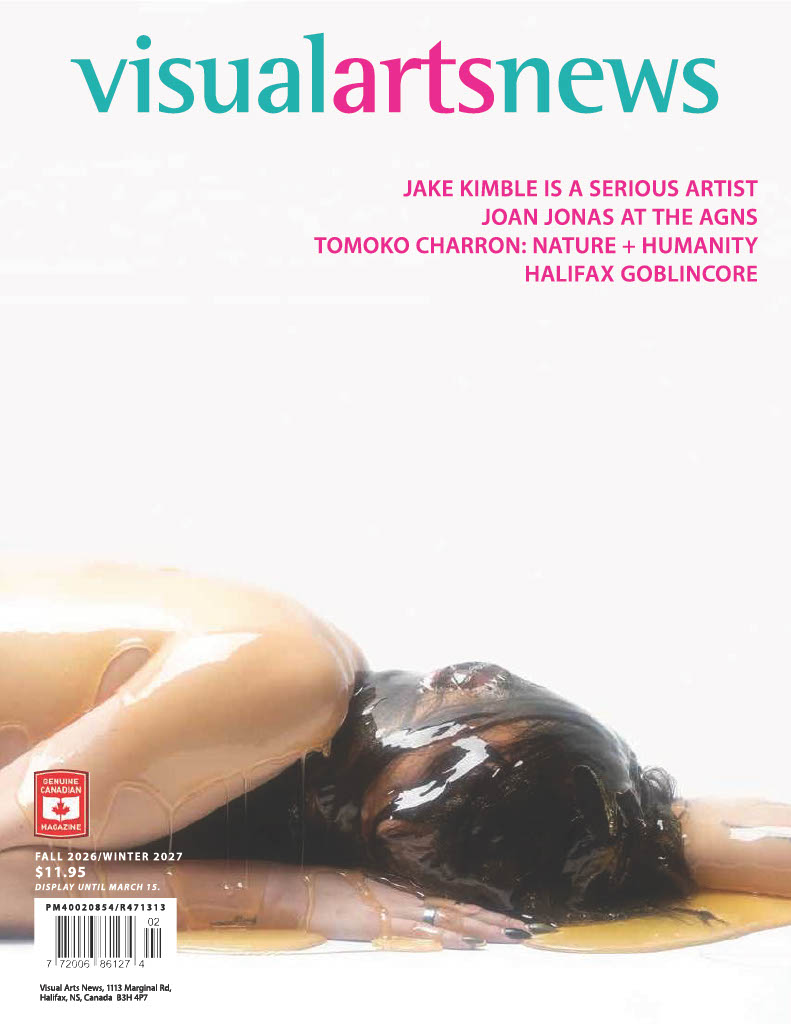
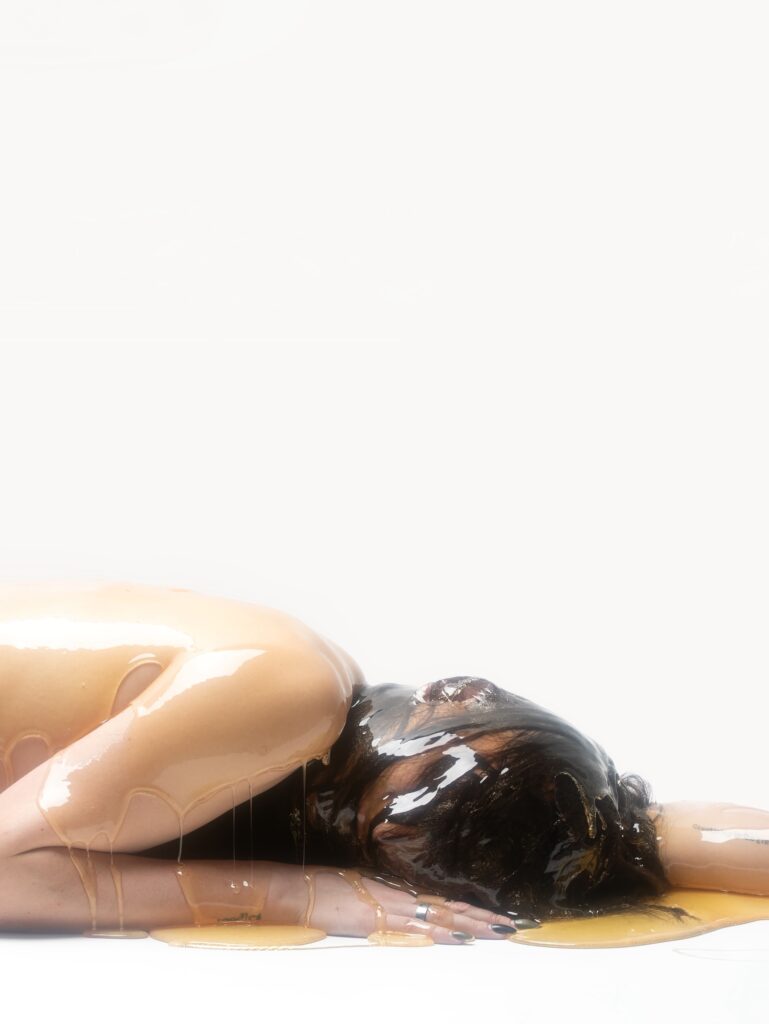
At the heart of My Bones Are Funny are two pieces that face off in the middle gallery space: My Guardian Angel Is Tired (2023) is hung across from the video installation Things I Learn From My Grandmother’s Giggle (2023). My Guardian Angel is a large five-part self-portrait, which exhibition curator Emma Hassencahl-Perley informed me was actually installed by the artist himself. “It was so art school,” she says with a laugh. “He bent the wire against a doorframe and nailed it into a two-by-four.” In each of the five photos, which together form one complete self-portrait, Kimble is covered by a different substance: dirt, sugar, honey, bubbles, and snow. According to Hassencahl-Perley, each material has unique significance. The dirt signifies buried sexual trauma; the snow, an absence of emotion. The honey pulls double duty as a symbol of alcohol abuse and of preservation, honey being the main ingredient in mead but also the only food in the world that never expires. The sugar indicates addiction, and the bubbles, levity.
Manulife Corporate Art Collection. Photo: Michael Mohan.
The video installation across the gallery is domestic, perhaps even mundane at first glance: the artist, off-camera, asks his grandmother to translate English phrases into Chipewyan. “This is my house,” says Kimble from behind the camera. Their grandmother interprets the phrase, bursting into a giggle at the end. Her laugh is warm and infectious, her smile lines deep; she sits with her hands behind her back, open to the camera. “What do you want?” says Kimble. “Who are you?” These questions, in the context of the colonization of Chipewyan lands by European settlers, juxtapose eerily with Kimble’s grandmother’s ease in her home. Interspersed with these interview clips are shots of waves lapping at a shoreline, quiet and constant. Love and affection flow effortlessly between the artist and matriarch. “The things I learn from my grandmother’s giggle can never be taught inside a classroom,” writes Kimble on their website.
In the series Grow Up, Kimble presents more self-portraiture, this time a combination of current and childhood photos. Over these, they have pasted shiny letters resembling party balloons. They spell out maxims that combine personal reflection with levity: “take yourself to seriously” [sic] reads Grow Up #13 (2022), a pouty glamour shot where the artist sports a string of pearls. Hassencahl-Perley tells me that these pieces were inspired by the artist’s therapy sessions, wherein they spoke with their inner child. Coming of age, the loss of innocence, and surviving one’s twenties (arguably the last time most people can acceptably behave like children) are all mourned in these playful works.
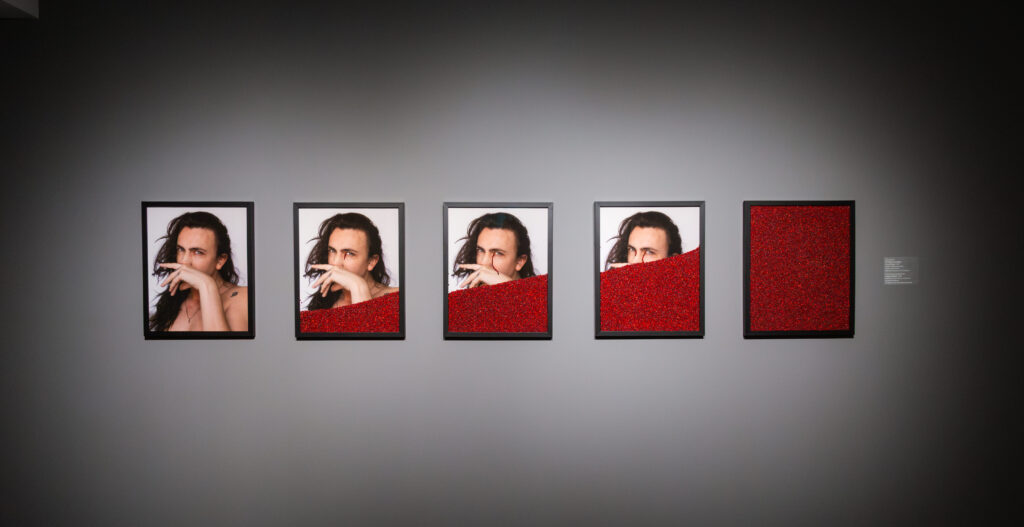
Another exhibition highlight is It’s All So Incredibly Loud (Rage) (2025). This series of self-portraits is embroidered with tiny, blood-red beads, which gather at Kimble’s tear ducts and gradually fall, filling the frame.
“My great-grandmother was a beautiful beader,” writes Kimble, “my grandmother could bead, my mom can kind of, and I can barely. It’s All So Incredibly Loud talks about having the knowledge of a historical expression inside of you but not having direct access to that knowledge.”
Beadwork is a cherished art form and traditional practice in many Indigenous cultures; to this day, beading often carries important symbolism, tells stories, and serves as a historical record. Despite the efforts of colonizing bodies, Indigenous beadwork has survived as an enduring art form.
“While mainly speaking about reviving knowledges within the body, [It’s All So Incredibly Loud] also explores the overwhelming nature of being alive and the loss that comes with it,” writes Kimble. “There are days […] where the grief is barely visible and days where it is the only thing I can see, it really depends on the day, which is also why I made the conscious decision to add loose beads physically inside the frame, it always shows up different.”
When I meet Jake Kimble for the first time, they’re sitting behind a table with Emma Hassencahl-Perley, and I have to dodge the many gallery visitors approaching to have their books signed by the artist. Jake has a new tattoo, which is visibly crispy, and they confirm for me with a laugh that it is definitely itchy.
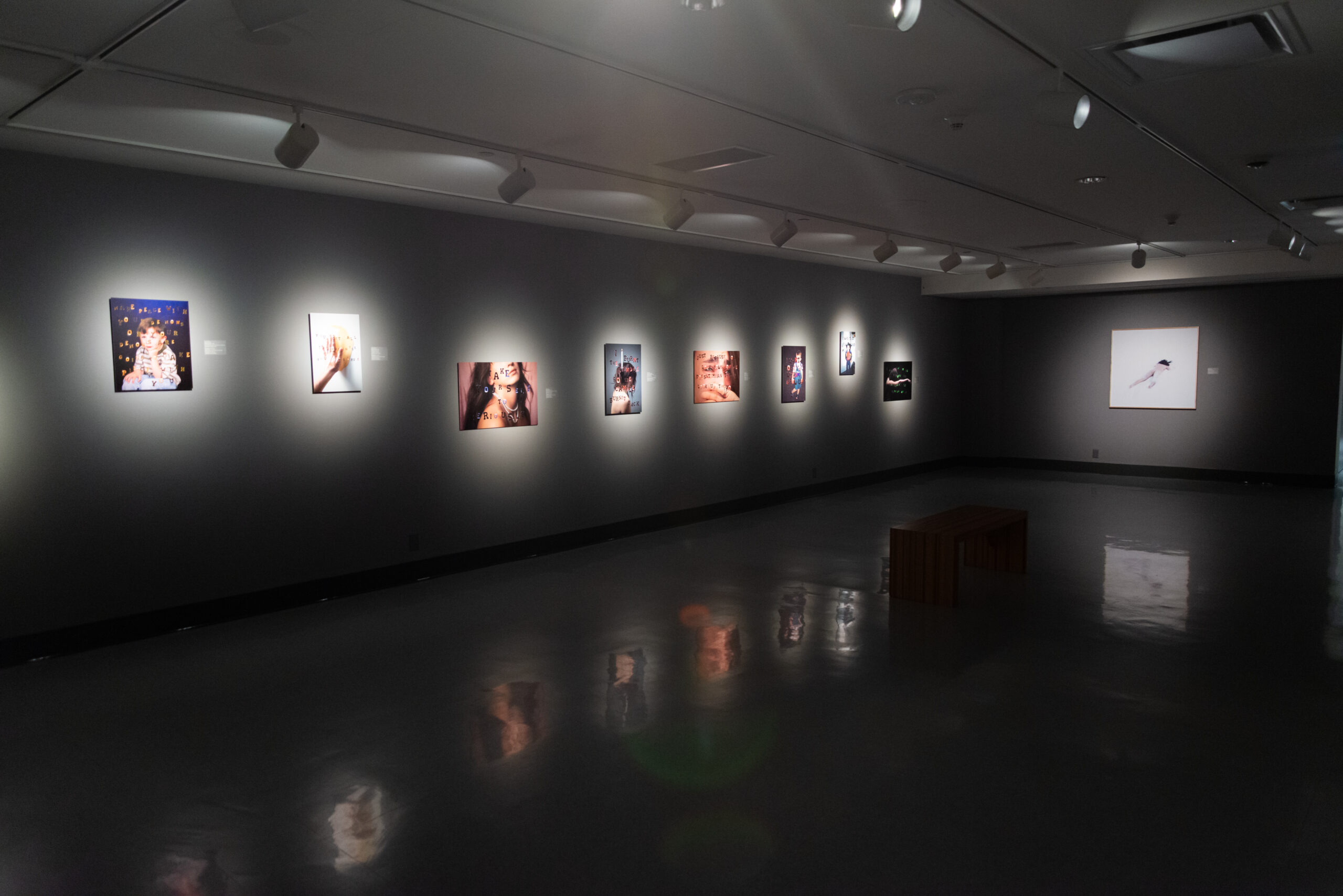
Photo: Michael Mohan.
“It’s a Florence and the Machine lyric,” they say, indicating that it stretches all the way from shoulder to wrist. “I was just listening to Lungs this morning in my car,” I blurt, which is true but feels like something a journalist would make up to make their subject feel at ease. As more patrons cluster behind me, I quickly get Kimble’s email address and promise to reach out soon.
I visited the Beaverbrook on a warm Thursday evening while most people were still in five o’clock traffic. In the quiet of the gallery, while I was watching Things I Learn, I heard a sudden exclamation: “WOOOAAAAHHH.” Two young men, in jerseys and baseball caps, had snuck in without my notice, and they were staring at My Guardian Angel Is Tired in awe. “Jake…Kimble,” I heard one of them say, as they searched the artist up online on one of their phones. I would love to know what struck them, but I think that’s also the beauty of the piece: it’s multifaceted, such that you never know how it will resonate with another person.
My Bones Are Funny, Sometimes They Ache is human messiness, and that’s what makes it engrossing. Kimble’s self-portraiture plays with Western gender roles, teasing the line between masculine and feminine, celebrating their Two-Spirit identity. Double entendres abound in Kimble’s performance of gender and in the language used to describe it. Translation and interpretation between Indigenous cultural mainstays—art forms, languages, gender expressions, all the practices that make a people—and their Canadian counterparts form an evident throughline in this exhibition. Many of the pieces are named in English but include a Chipewyan parenthetical title; the deliberate historical attempts of colonizers to eradicate Indigenous languages contextualize Kimble’s decision not to translate every single word into English. It feels like the artist is gently saying: Yours are not the only words that matter. Listen, let me (and my grandmother) teach you something.
Emotion spills over everywhere in this exhibition, whether it be in sticky sweet honey, overflowing tears, a pie smashed into a face, or the prints made using paper towels as canvases. Kimble neglects to clean up for us. He flaunts this truth, this reclamation of body and all of its uncomfortable ambiguities. Their (sometimes literally) cheeky self-portraits are strange enough to make us laugh and vulnerable enough to make us cry.
“Jake doesn’t like to describe [humour] as a coping mechanism,” says Hassencahl-Perley. “It’s more of a survival instinct.”
After all, the funny bone aches, too.
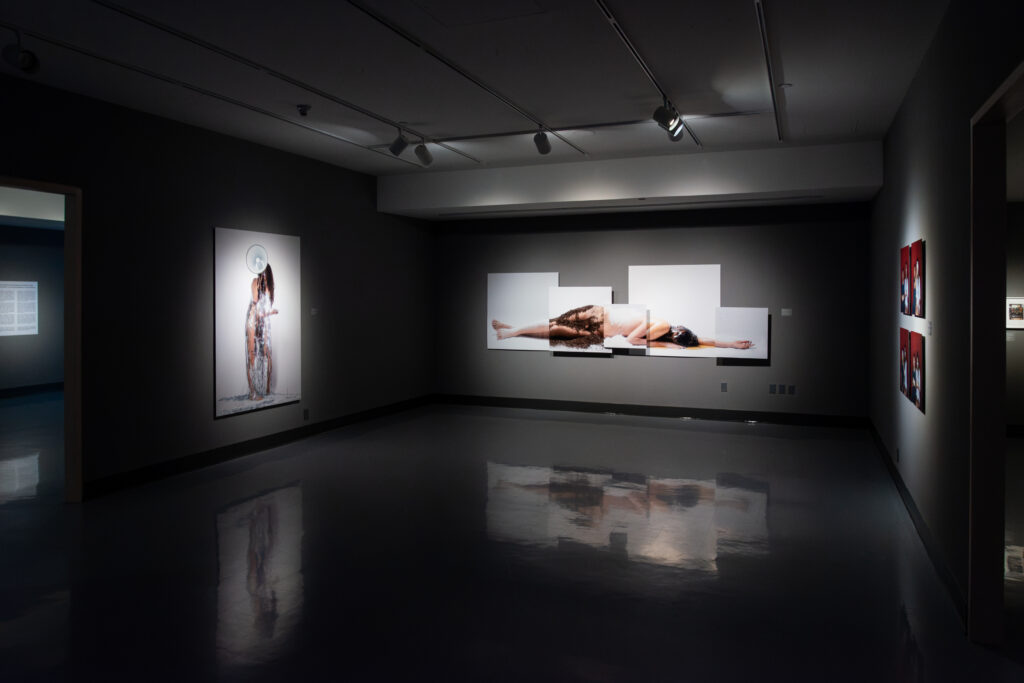
Photo: Michael Mohan.
Shannon Harvey: It’s clear from my visit and from speaking to Emma that humour is a central theme in this exhibition. What is your personal sense of humour like?
Jake Kimble: I have absolutely no idea what you’re talking about. I am a serious artist.
SH: Alongside the humour, there are veins of grief, rage, and coming-of-age / loss of innocence throughout this exhibition. Can you speak to how (and why) you wove these feelings together?
JK: One of my favourite lessons I’ve learned with growing older is that those two feelings do not have to be mutually exclusive and are more often than not bedfellows. I had an acting teacher once explain that there will always be joy when expressing sadness because when someone truly allows themselves to feel—whether that be anger, fear, or pain, et cetera—authentically it feels good. Because it feels good to honour your body and your spirit.
SH: There is a lot of wordplay going on in My Bones Are Funny, and you invoke your grandmother’s first language in a beautiful video installation where you ask her to translate different phrases. You also do not exclusively use English in the titles for your pieces. Can you tell me about your use and choice of language?
JK: I’m thinking about accessibility to language, particularly my access to my native language Chipewyan, which I am still learning. I’m trying to wake up the language for my tongue. I should know how to speak Chip, but it’s minimal at best, so naming works of mine [using] phrases in my language helps me practise and keep it awake.
SH: Were there any significant challenges or personal struggles that emerged while creating these pieces? If so, how did you overcome those or incorporate them into the works? Or, alternatively, did the entire process go smoothly, and if so, why do you think that was?
JK: It’s been so lovely to see all of these works shown together, because it’s almost a soft retrospective of my development—both as an artist and as a human being. Uncovering who I am and seeing how I operate is a fun thread that connects them all. I think overcoming my preconceived notions of what makes a “serious artist” is something that I learned to get over pretty quick, but making sure I stay over that idea is what has actually been challenging. So just remaining true to me and my funny way of doing things is what I hold on to, because that is what resonates, I find.
SH: Is there one work from this exhibition that you would consider the “heart” or centrepiece of My Bones Are Funny?
JK: My Guardian Angel Is Tired, I think, is the anchor of this exhibition, it is very much the work that exists in the middle of all of the pieces and connects them all.
SH: Are there any other themes that emerged while you were working, perhaps themes you were surprised by? Are there themes that you find people often don’t pick up on, that you wish they saw or felt?
JK: Seeing them all together was an interesting thing for me, because I never really understood how much pain there is in the works (don’t get me wrong, there is just as much humour). Recognizing that has made me hug myself a little more and treat myself with a little more kindness.