by Ross Nervig
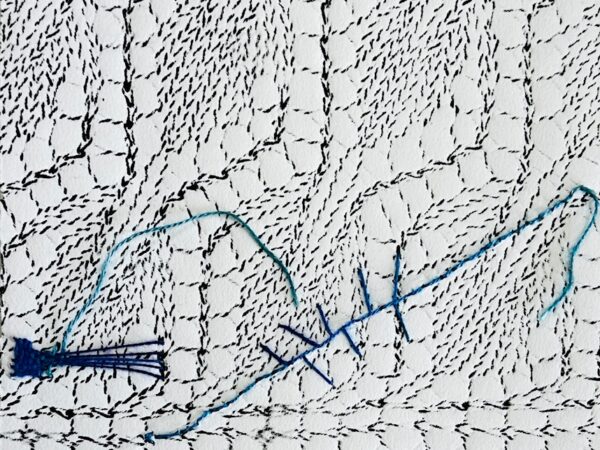
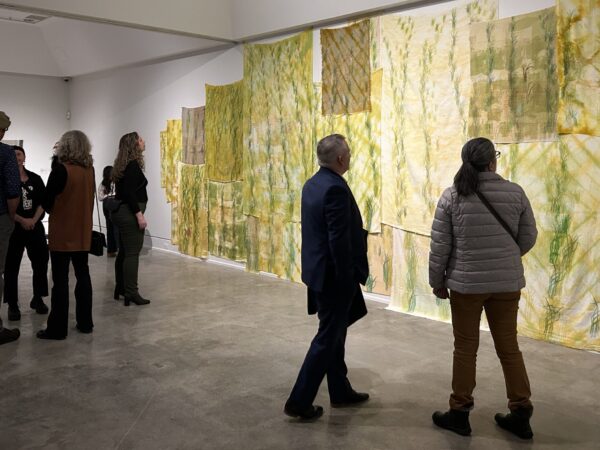
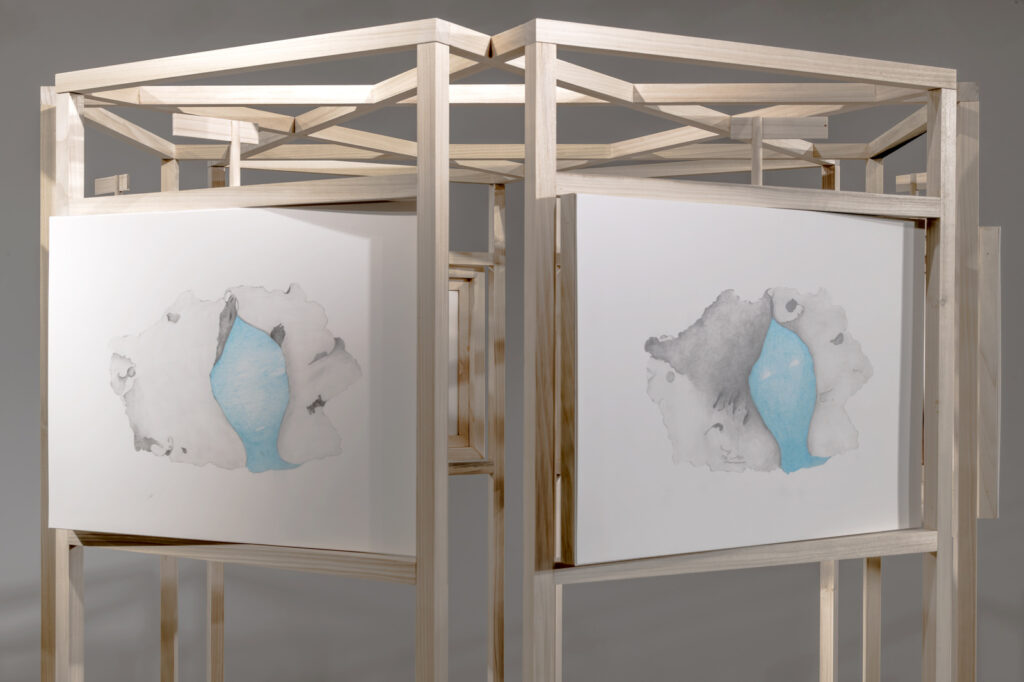
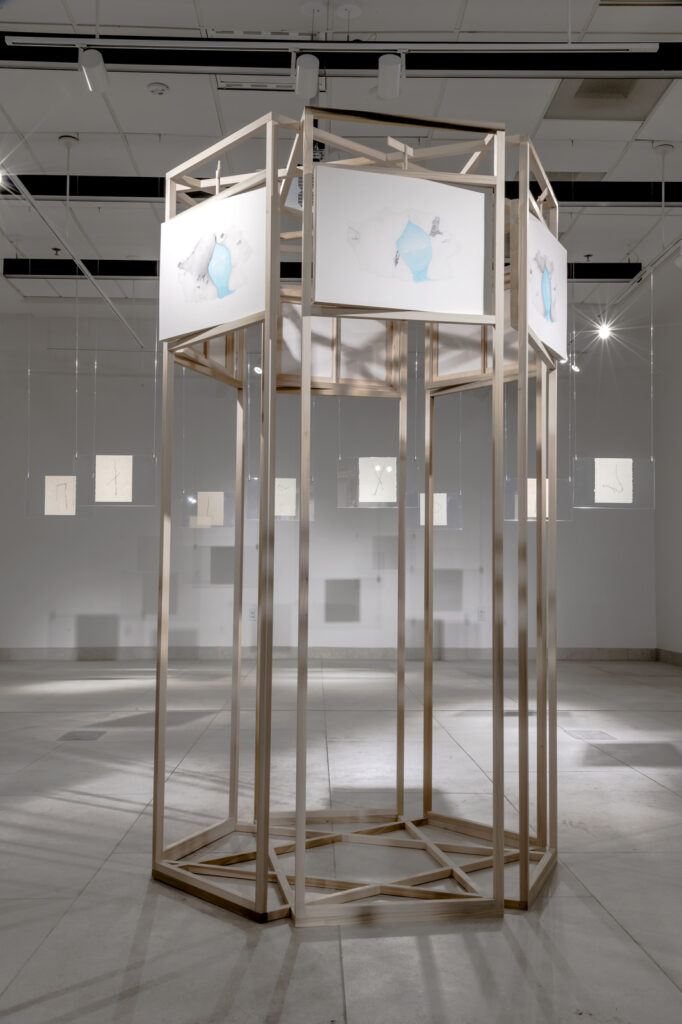
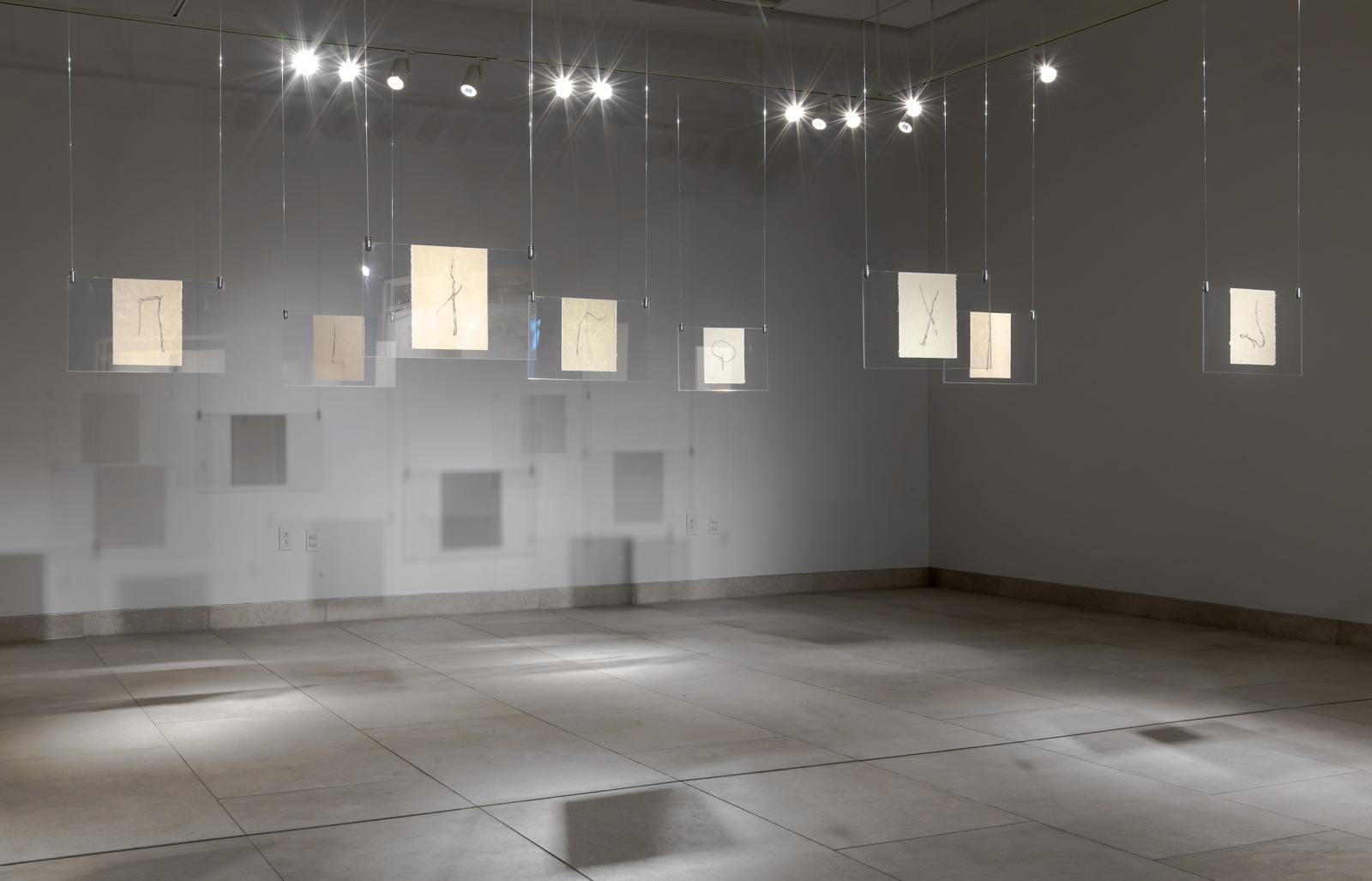
In mouth them like words, Angela Henderson welcomes viewers into a space that feels quiet, careful, and a little mysterious. On view at StFX Art Gallery from February 25 to April 4, the exhibition brings together graphite drawings nestled within free-standing wooden structures that subtly shape how you move through the gallery. Her line work shifts between intention and instinct, between the clarity of design and forms that seem to rise up from somewhere harder to name. The installation feels like a living archive, one that asks you to slow your pace, come closer, and spend time with images that do not resolve all at once. In this conversation, she reflects on ambiguity, restraint, and the conditions she creates to allow something unexpected to surface.
Your title, mouth them like words, feels tactile and embodied. Where did that phrase come from?
A lot of the titles I’ve used in the past have come from poetic references—Anne Carson and Forugh Farrokhzad—but not this one.
My partner is a poet, and reading his work influences me. I think I’m inspired by the embodied quality of words on the page—language in any place, really. Lately, a lot of my work has resulted in hybrid forms that are hard to name. I was thinking about the mouth as the place where we speak language. There’s this visceral, mouth-like quality that feels close to naming but also to being unable to name.
If I were to think about a mouthful of ambiguity—how would I name it? I don’t know. That’s kind of where the title comes from.
Many of the forms feel pared down, almost elemental. What draws you to that economy of line?
My background is in design, particularly architectural and spatial design. I’m interested in material quality and structure. Often my drawing practice veers toward the maximal—more and more and more—but the structures that hold those forms feel like metaphysical devices. They’re frameworks that hold ambiguous life forms or images.
There’s a contrast there. The structures are drawings in and of themselves. I imagine them as part of a lifelong system—an ongoing design and development of these forms. They’re members of a kind of evolving structure.
Where did this body of work feel most difficult?
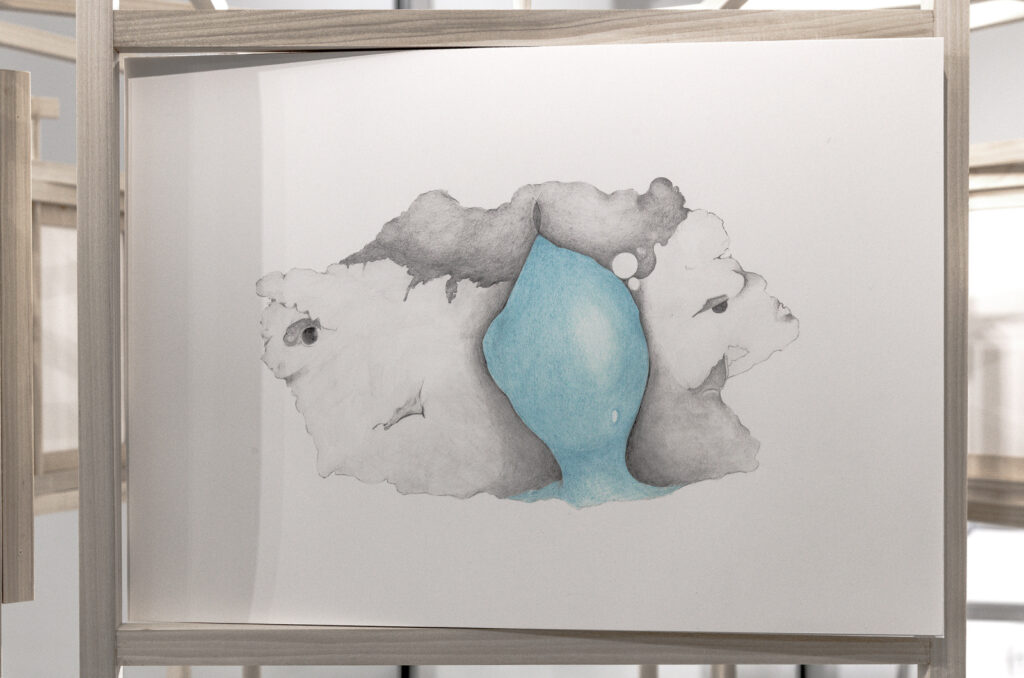
There’s always a lot of fastidiousness in what I do—time spent. In the drawings, especially, I’ve developed a practice that tries to create the conditions for something meditative, where the subconscious can come forward. It becomes about drawing and witnessing what emerges.
That sounds good, but often it’s frustrating. Creating those conditions isn’t always easy. It depends on mood, on the day.
I’m also a parent. There’s guilt—long periods spent alone are when that process becomes most accessible. Sometimes I feel guilty for that. Other times I feel like I’m not spending enough time with myself. It’s a difficult balance.
Do you think of these works as contemporary, or as belonging to a longer timeline of mark-making and symbolic practice?
Both. There’s something pre-verbal in the work. Through the process I described, forms emerge that are hard to name. I relate that to ancient or pre-verbal knowledge.
At the same time, practices like tarot or divination tools project a way forward. They depart from rationalist binaries—right/wrong, good/bad—that we see increasingly in society. There’s hopefulness in ambiguous or mysterious tools. They propose alternative ways of seeing and naming.
How do orientation and scale shape the viewer’s experience?
You have to look at my drawings with dedication. Often your body comes very close to the paper. The viewer is rewarded by spending time.
In this exhibition, I thought about ambulating—about circumambulation, which suggests ritual or spiritual practice. Ambulation isn’t a straight line; it’s circulatory. I also tried to insert my own body into the forms, literally, through scale—heights, widths.
I wanted to create a scaled environment that slows the viewer down and brings them close to the surface.
How does a drawing begin for you? And how do you know it’s finished?
A drawing begins as curiosity or observation. I often work with found forms. I might trace something—blind contour, physical objects, or carbon tracing. The reference point is intuitive, often coming from walking, being in nature, observing trees, leaves, insects—things outside my window.
I’ve also worked with psychoanalytic practice for about eight years. I use tools that access subconscious thought—active imagination, for example.
I don’t use erasers. The drawing evolves. I follow what emerges.
As for finished, it’s a feeling. When there’s enough depth and complexity, I feel it’s complete.
The works hover between abstraction and something almost legible. Are you interested in that threshold?
Yes. Ambiguity is a goal in my work. I value holding multiple things at once without resolution.
I’m interested in how images unfold and contain many references. I love the work of Marcel Dzama, for example. I feel a trajectory toward identifying figures or reference points that could develop a narrative quality.
How did the installation shape the meaning of the work?
When I installed the show, I realized I had designed the wooden forms to meet and facilitate the drawings. I imagine those structures returning in future exhibitions to house new drawings—like a growing archive.
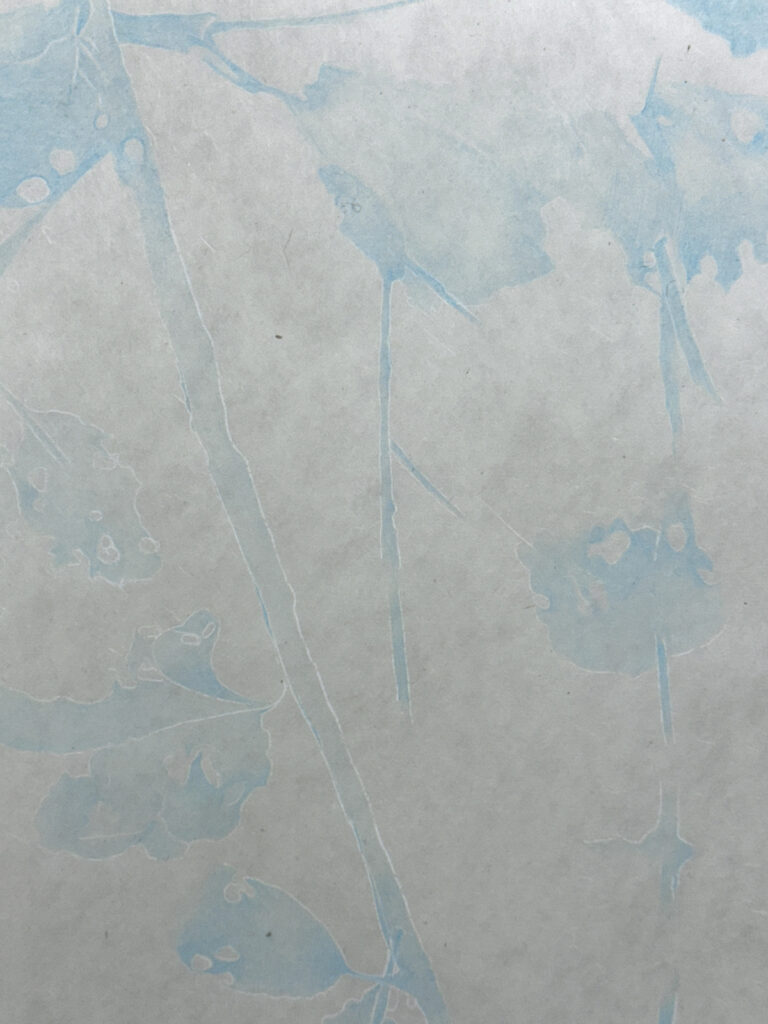
I was trying to create a quiet archive. The line work and forms reference botanical drawing—the way we archive and document plant or animal life.
Can you speak about your material choices—graphite, coloured pencil, mylar?
Many materials come from my design background. I use CAD for structural designs. The washi paper I work with is incredibly responsive to graphite—it holds it in nuanced ways. At times it feels like a dead end, but it does something specific.
In this show I experimented with watercolour paper in the central form. I’m interested in moving toward tracing papers or translucent materials—where drawing becomes more three-dimensional.
The blue pencil comes from architectural construction lines. When plotted, those lines disappear. They’re subtle construction marks.
There’s quietness in the exhibition, but also tension. How do you think about restraint?
My process can be obsessive, right up until the night before installation. I’m always trying to pare things down.
There’s restraint in how the pieces fit together, the structures that tilt and move, almost like flat-packed furniture.
I grew up in a small closed religious community. Dogma is something I’m embedded with but push against. Restraint sometimes comes from setting rules: no colour, one colour, this paper only. Creating conditions through limitation.
There’s much more work that isn’t in the show than is. Sketches upon sketches—my own archive in manila folders.
Do you think of drawing as a form of divination?
I like that idea. Without erasers, drawing becomes like watching clouds. “Oh, there’s an ear—I’ll follow it.” Sometimes I almost speak to it: Why are you here? What are you showing me?
It may sound strange, but I’m trying to draw from subconscious space. Perhaps even from a collective unconscious—the roots under trees, the mycelium.
The divination, if anything, is about creating conditions for unfolding and then letting it happen. Witnessing and participating while trying to quiet the thinking mind.
Everything begins with close observation—botanical forms, trees, leaves, insects. But once that reference is on the page, it departs. The visible is the starting point. Through process, it becomes post-observational—an unfolding.
Ross Nervig is the Editor of Visual Arts News.