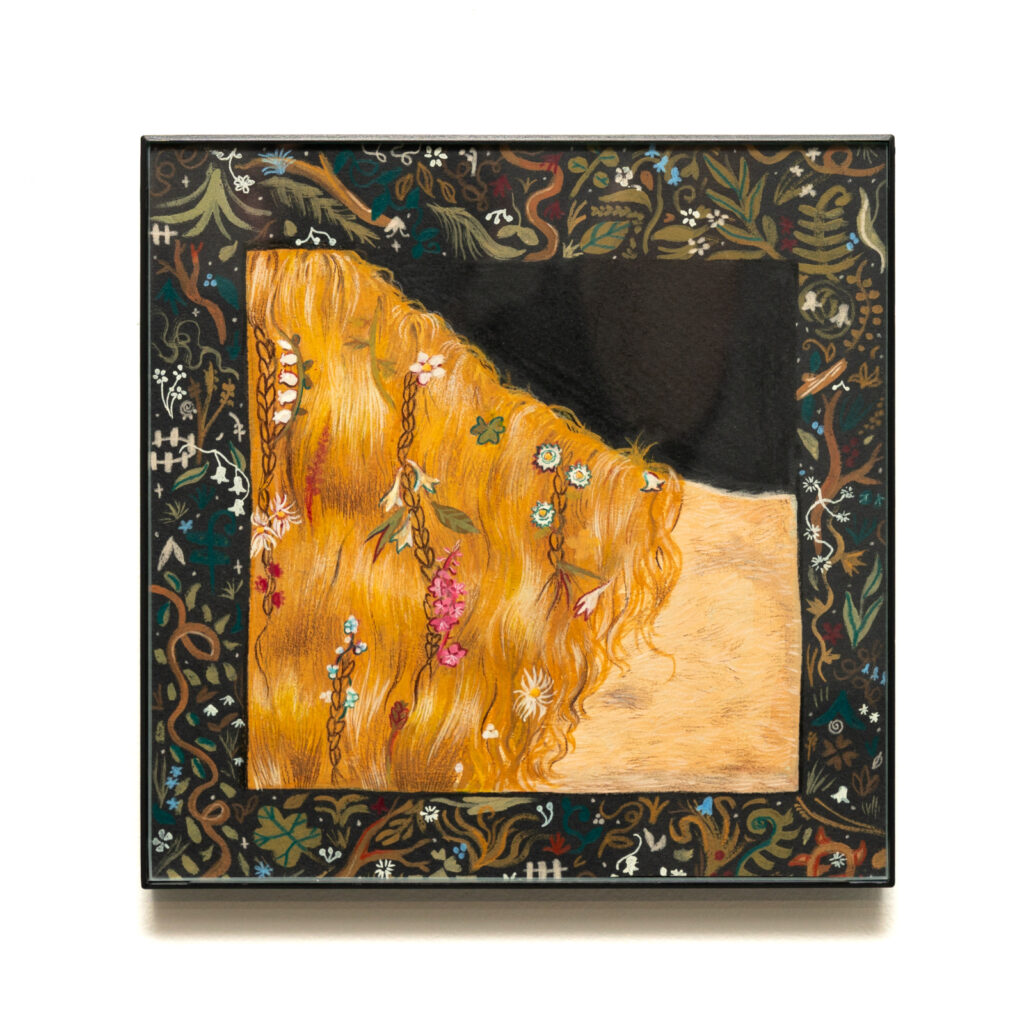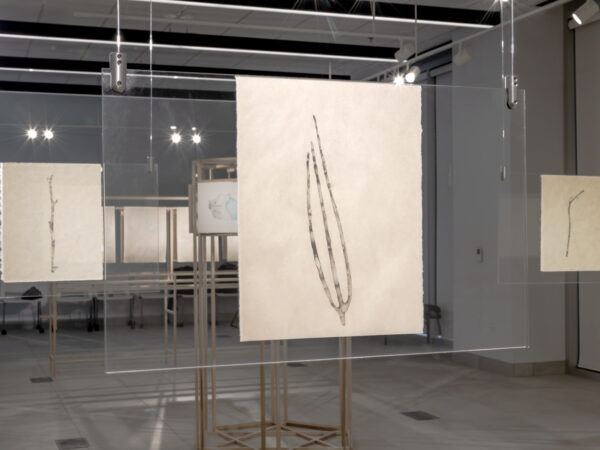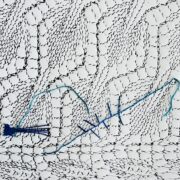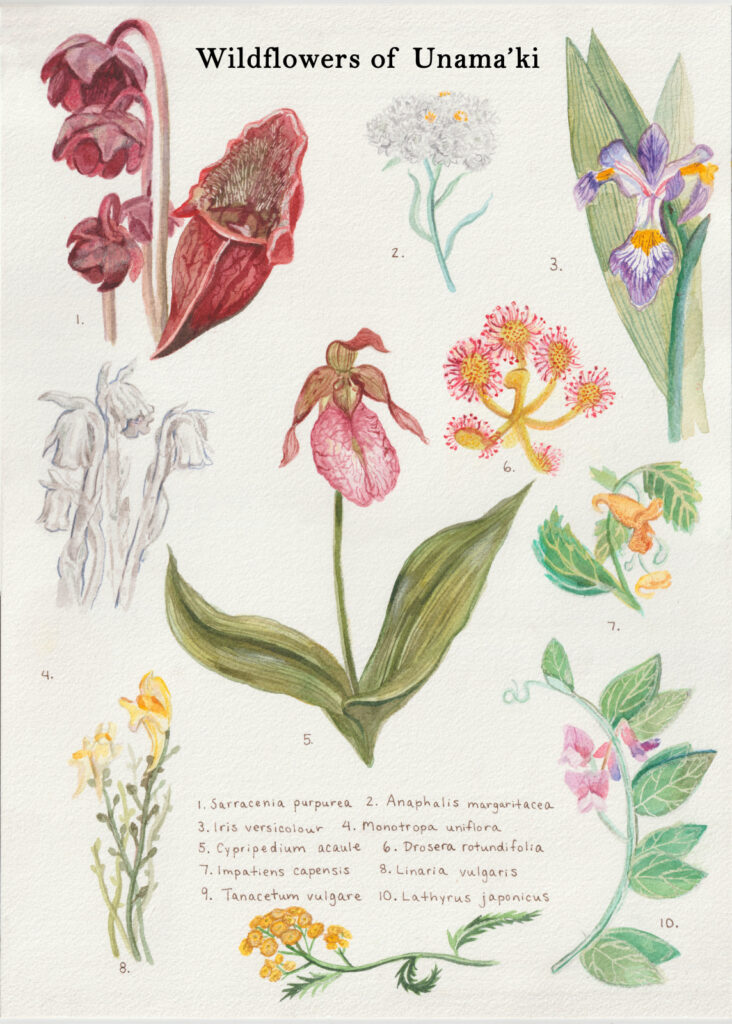
Rooted in the forests of Cap Rouge, Donica Larade’s art practice highlights native flora and fauna and encourages conversations around conservation, ecology action, and queer experience. Donica’s ability to capture fleeting moments in nature’s moments of kismet is unique. Whether they’re exploring a fresh flush of edible maritime mushrooms, studying the anatomy of a Highland fairy, or embedding sea rocket and a gannet wing into a cyanotype quilt, her attention feels exact and alive. Her unique ability to articulate a moment shines through.
Larade comes from an Acadian family displaced in the Expulsion, and the stories of that time live on in her art and profound relationship to the Cape Breton Highlands. Her mediums shift with the seasons, but an environmental throughline ties the work together.
In the wild, you’ll find Donica carrying a large tote bag full of various art supplies: some gouache, a well-worn watercolour palette, acrylic paint markers, or even cyanotype chemicals—she’s primed to create at a moment’s notice. A self-proclaimed jack-of-all-trades, their practice moves fluidly across materials, often drawing on second-hand finds and objects from the natural world. Donica’s work reminds us that realism doesn’t have to omit mysticism and storytelling.
Kyra Lambert: Tell me a little about your arts practice as currently is and where you tend to draw influence from.
Donica Larade: My process of creating has always been chaotic and unpredictable. Everything in your life has the ability to inspire art, especially the unexpected or mundane. Some concepts creep up and grow slowly over time, and some hit me like a freight train. I’ll be watching a movie or in the grocery store and frantically scribbling something down in my notes app. Sketchbooks then help me flesh ideas out and explore what medium to communicate them with. Themes I’ve been exploring recently involve mythology, philosophy, symbolism, death and natural cycles, local plants and animals, social justice movements, and generally the whimsy of the natural world.
KL: How does your Chéticamp home base influence your arts perspective and practice?
DL: Cape Breton is one of the only places I know where being an artist is taken seriously as a career path. Growing up spending time in Chéticamp, I was influenced by theatre productions, musicals, dances, and festivals that showed me art was culturally essential. As a kid, I walked door to door selling my drawings because I felt confident people around me valued art. A mix of wonderful landscapes, island artists, seriously funny people, and a rich culture that celebrates expression has been a winning formula for me.
KL: What pieces of folklore from Cape Breton do you hold close?
DL: The fairies of Cape Breton Island are the creatures I’m most drawn to in regards to island mythology. The folklore I’ve most heavily focused on in my previous work has explored visual symbolism and tales associated with fairies. Something that compels me most about fairy lore is their presence throughout various communities found on Cape Breton Island, such as the Mi’kmaq, Gaelic, and Acadian people. It’s very telling of their cultural impact and powerful abilities.
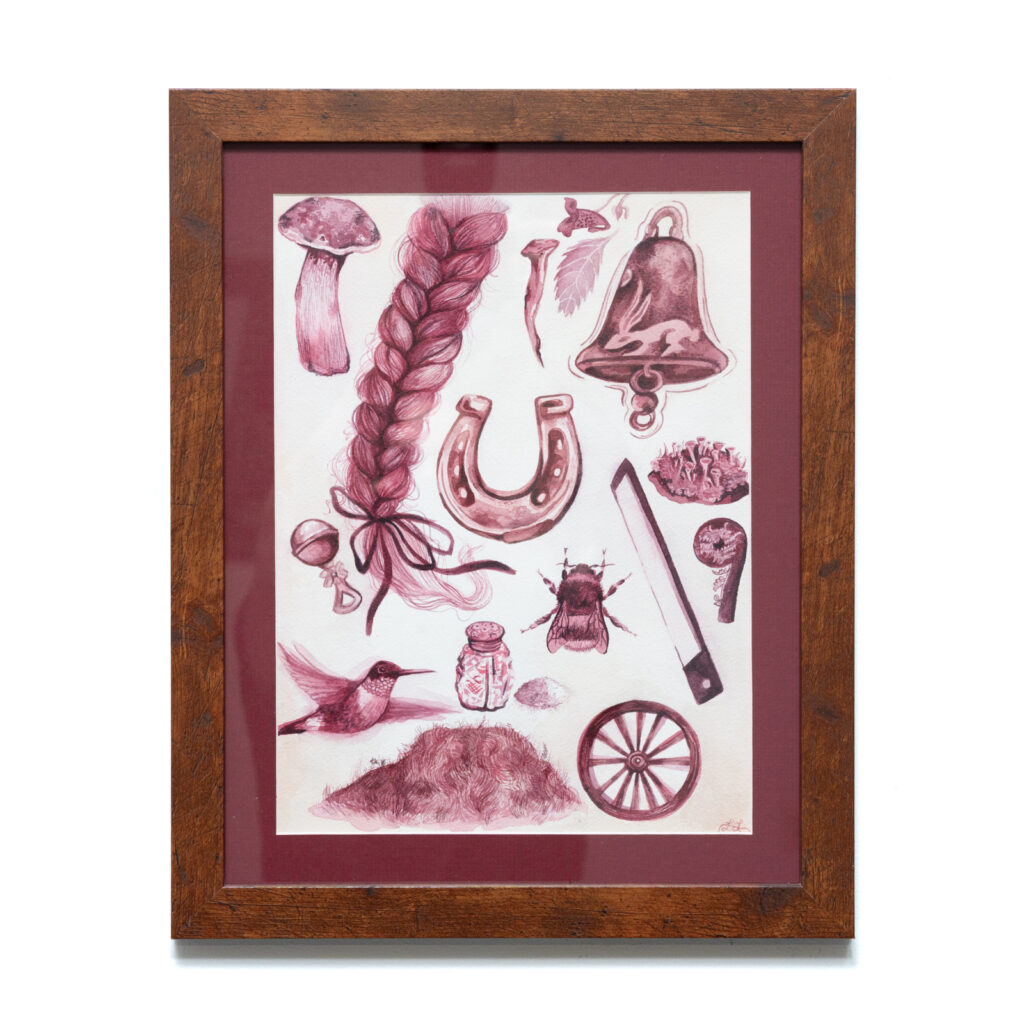
KL: All art, yours especially, “keeps record” of species and stories around our immediate environment. What drew you to this type of art practice?
DL: I think what first drew me to this type of note taking was in part my own discovery and curiosity for the species that lived locally. Observation and pattern recognition is a part of both the scientific and artistic process. I constantly traipse around with my nose inside guidebooks or the apps eBird and iNaturalist. The realization that many people are unaware of some of the amazing species in their own backyard and have that same curiosity pushed me into this style of highlighting them in my art. Flying squirrels, purple coral mushrooms, and saw-whet owls are only some of the incredible, unique species that people might not associate with the East Coast.
KL: You have a very special ability in connecting people to the wealth of species in their immediate environment. Do you have any stories that come to mind when you think about introducing people to local invertebrates, or mushrooms? (Connecting people to their environment can be so empowering and supports interdependence, accessibility in education through the arts.)
DL: I think it can be difficult to choose one specific memory because of the way it’s completely integrated into my life and daily activities. However, some of my most memorable experiences in scientific communication have been with children. They are the most curious, ask the best questions, and hold the most unbridled joy. In our interactions, I often find myself thinking more creatively, pushing the limits of my own understanding, and being challenged into trying to explain complex genetic theory to an eight-year-old asking about butterflies. It’s incredibly rewarding to support young people on their own journeys of understanding the world around them.
KL: How do you interact with the wider Nova Scotia arts scene? Where is your place in it?
DL: Coming from a non-traditional art background has in turn led to a non-traditional relationship with the Nova Scotia art community. At times, I’ve felt isolated as an artist because of my lack of formal education. It can feel difficult to make connections and obtain the right resources without the formal structure that school can offer. Thankfully, living in small artistic towns like Chéticamp, Seaforth, and Antigonish, and taking part in residencies and festivals, has been deeply healing for my imposter syndrome. These experiences, as well as making connections with other artists and mentors, have allowed me to mitigate my feelings of insecurity in my art practice and feel like an essential piece in our art world. It takes all kinds in the arts, and my unique journey and experiences created my own niche in the scene.
KL: How does art influence ecologically minded spaces? Is there a specific conservation effort in NS you’d like to call attention to?
DL: Traditionally, art and science have always been entwined in a way in which one was rarely found without the other. Note taking, sketching, or illustrating are an essential resource in the sciences to help convey information. Looking back at extraordinary naturalists like Maria Sibylla Merian, Ernst Haeckel, or Anna Atkins, I think the relationship between science and art was much more widely acknowledged and appreciated before the twenty-first century than it is today. For me, the beauty of illustration and its role in the sciences is to communicate difficult or interesting concepts, advocate on behalf of species and the environment, and celebrate the mysticality of nature. There are too many amazing conservation efforts to mention just one, but CPAWS, Nature Nova Scotia, and the Ecology Action Centre offer great resources for conservation work being done in your area!