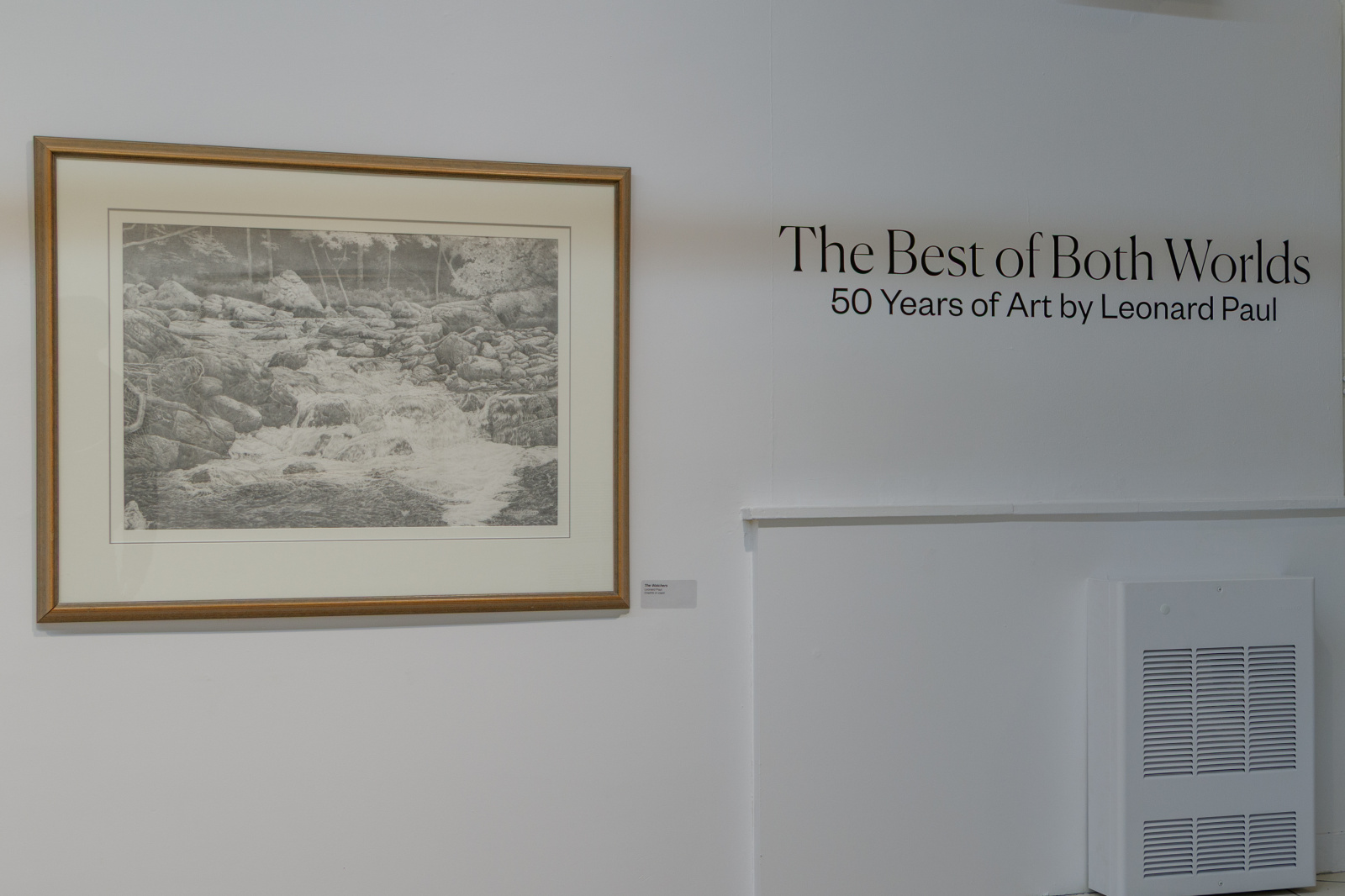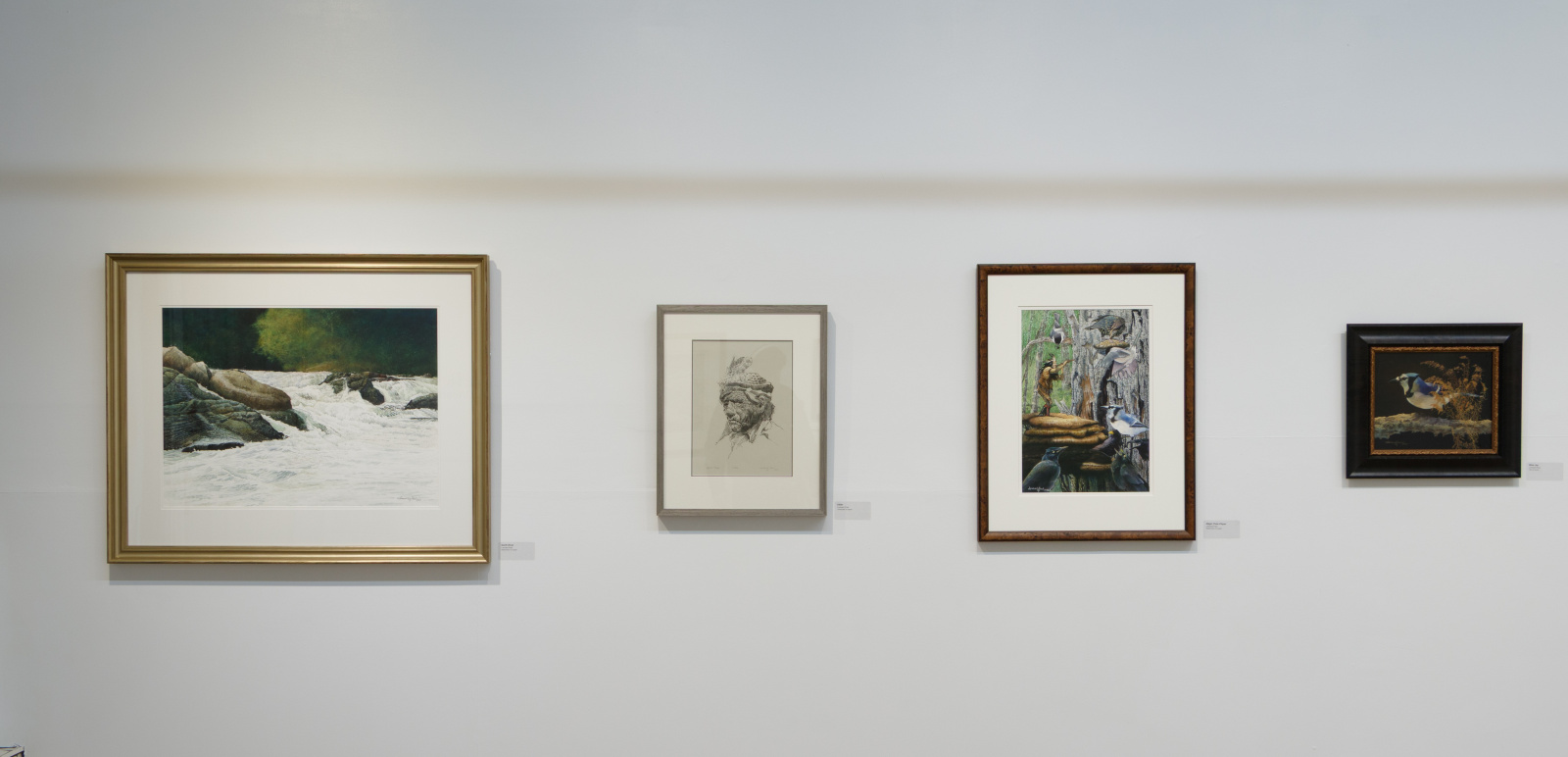
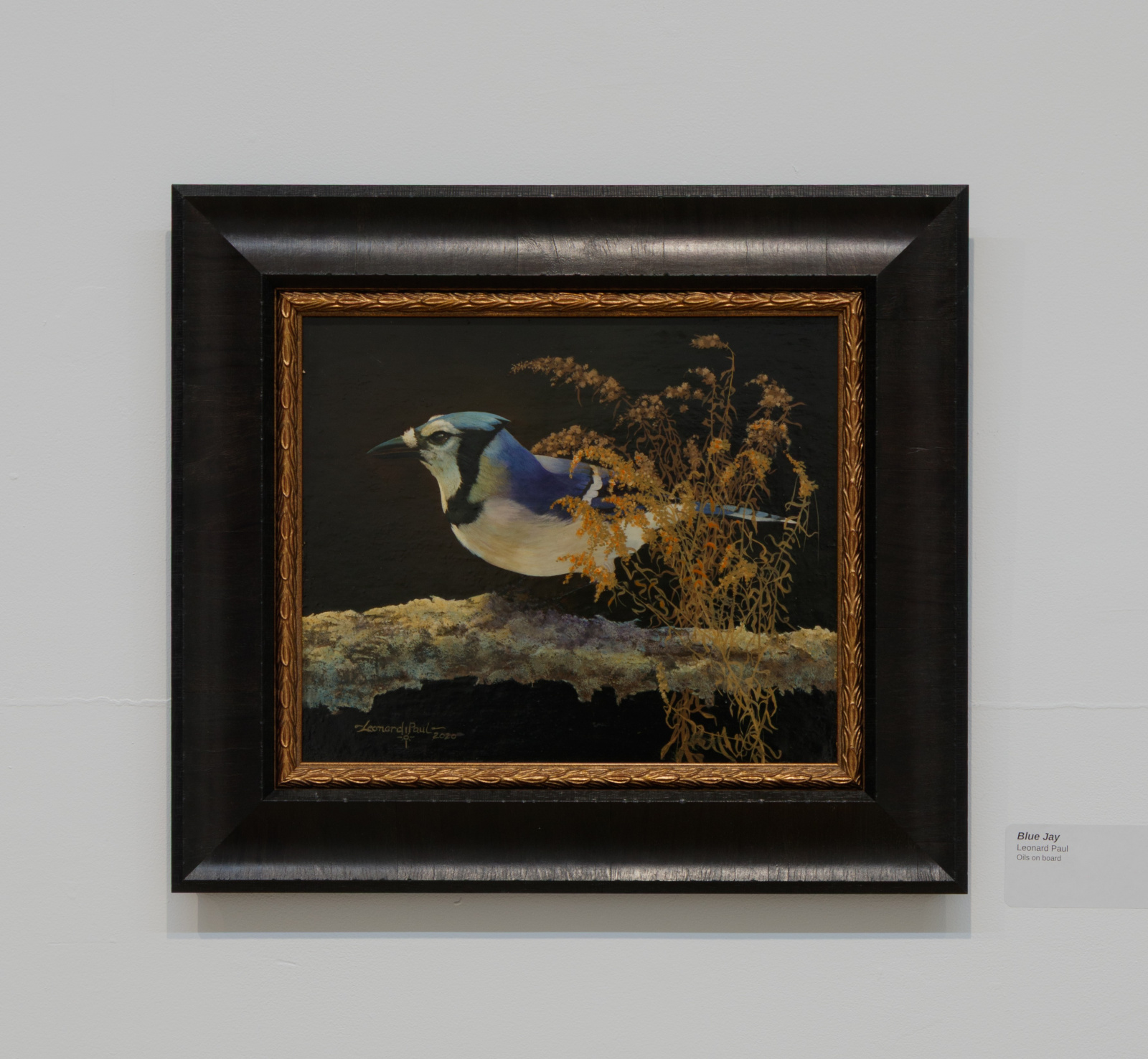
At Treaty Space Gallery, The Best of Both Worlds: 50 Years of Art by Leonard Paul gathers work from across a long career and lets it speak with a quiet confidence. Rivers churn through rock. Birds cling to the rough sides of trees. A wolf looks straight out from the frame. Moving through the gallery, you begin to notice the steady hand behind it all. Paul returns again and again to the living world around him, studying it closely and translating what he sees with patience.
Realism has always been central to Paul’s practice. While many conversations about Indigenous art have focused on symbolism or graphic traditions, Paul followed a different instinct. He was drawn to careful observation and to the painters who worked in that tradition. The works in this exhibition reflect that choice. They show an artist who trusts what he sees and who has spent decades learning how to render it faithfully.
When we sat down to talk about the exhibition, Paul reflected on what it felt like to begin exhibiting in the 1970s. Indigenous artists were rarely visible in the Canadian art world then, particularly in Atlantic Canada. Paul remembers feeling largely on his own at the time, guided mostly by his own ability and curiosity. Over the course of our conversation, he spoke candidly about those early years, about debates around authenticity in Indigenous art, and about the challenge of sustaining a creative life across five decades.
When you began exhibiting in the 1970s, how were Indigenous artists positioned within the Canadian art world? How visible were you?
Not very visible. Not very visible at all. When I came in, I felt like I was all by myself. And it really hasn’t changed much.
Did that make you feel lonely? Or did you feel unique?
I felt unique. Yes, I felt unique.
Without sounding conceited, I felt I was blessed with a very extraordinary ability to paint, and that ability spoke for me. It opened doors for me.
Over the decades, have you seen any shifts in how institutions approach Indigenous art?
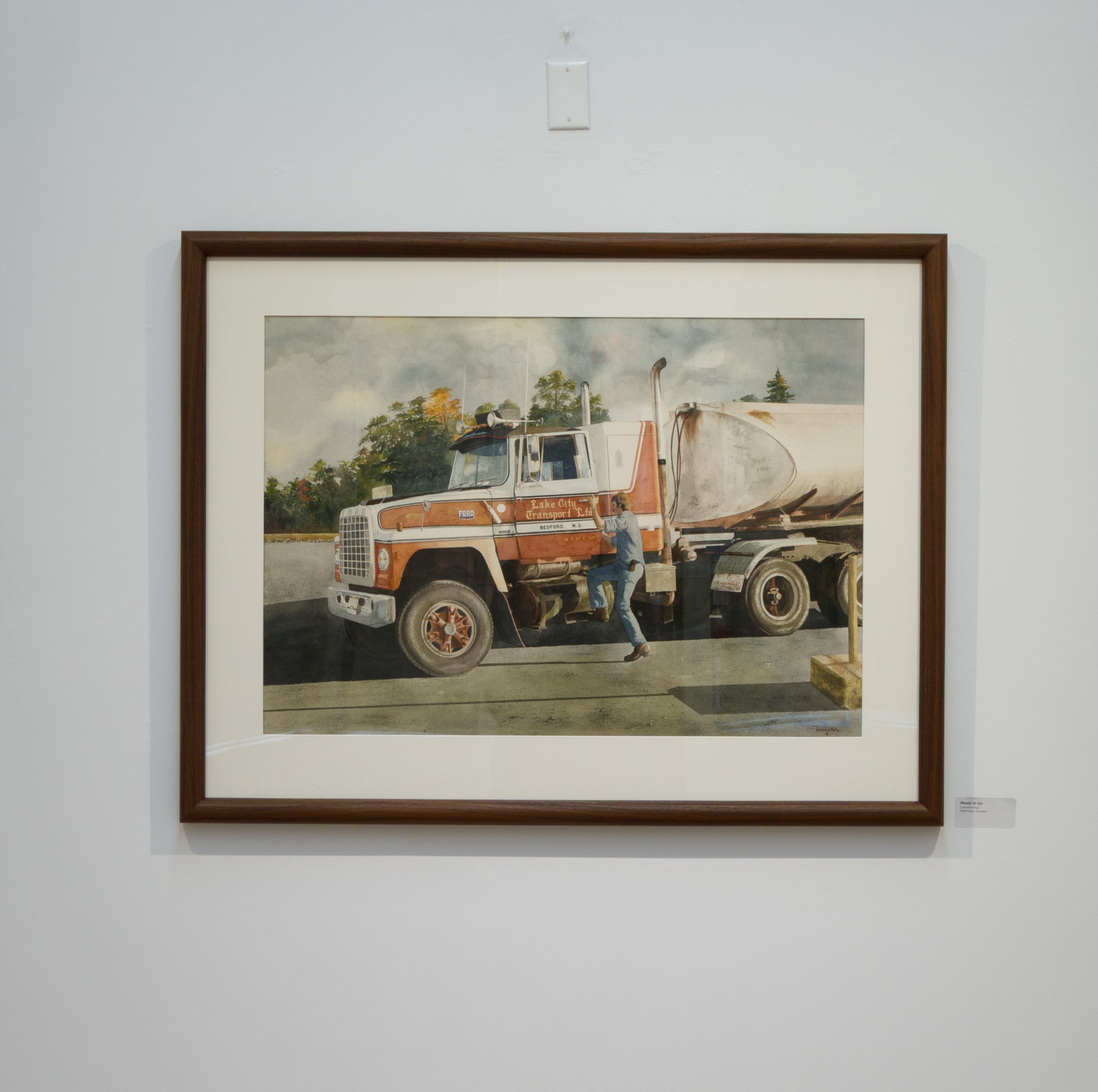
It was very provincial, if they did approach it at all. And that provincialism tended to centre Ontario or the West, not Newfoundland or Prince Edward Island or places like that. In one way we were secondary.
But thank goodness that was the start. We had Norval Morrisseau. We had Bill Reid from out West. People started to take notice.
I felt a little strange in some ways, because I wasn’t painting like they did. In those days I was painting realism. I was more comfortable with people like Alex Colville. I knew him as a good friend. I also knew Ken Danby. I was in that circle with them. I would be on the phone talking to James Lansdowne, the great bird painter. I just wanted to know more. He was so helpful. I never met him, but we had long phone conversations.
So in a way, that kept me at a distance from what people thought of as First Nations art.
There’s often discussion around “authenticity” in Indigenous art. Has that word felt useful or limiting to you?
Back in the late ’80s and early ’90s, we were asking, “What makes Native art? Who makes Native art? Do the artists have to be First Nations?” The answer we came to was yes.
I sat on the national art board for eleven years: SCANA, the Society of Canadian Artists of Native Ancestry. We became aware that a lot of people were coming in and identifying as Métis or Inuit when they were not. It became a kind of hodgepodge, and that got in the way.
Through SCANA, we were trying to establish criteria to solidify First Nations creativity, grounded in Native ancestry. We were trying to protect it.
What has been the most difficult aspect of sustaining a creative practice? Has that struggle changed over time?
Today I see emerging artists coming out and saying, yes, we are artists, and we’re not part of white society. We have our own identities, our own methodologies to create these wonderful designs. They’re part of our culture.
The question has always been what’s the criteria? And we’re still going through that today. We’re still trying to find ways to oust the fakes and to concentrate on people who are First Nations and haven’t yet had a chance.
We have more venues now, which is good. International venues too. I’ve shown in France and Germany on behalf of First Nations movements. That was good.
But it was a quagmire in those days. Terrible.
I’ll give you an example. Not too long ago, we went into a museum in Sherbrooke. There was a woman—white—talking to a group of people about her paintings in a Native pavilion. We overheard someone ask if she was Native. She said no.
Her husband had been a legitimate First Nations artist. He passed away. She picked up the paintbrush and painted like him and was selling the work as Native art.
I told the curator, “You’re misleading people. She’s not First Nations.” The curator said, “Her husband was. That’s good enough for us.”
That’s the kind of thing we had to deal with.
Have you ever struggled with creative blocks? What’s the most difficult part of creating a piece for you?
I was very lucky. I opened doors, but I never went into all the rooms.
By that I mean I didn’t go into symbolic, geometric Native design. I was comfortable in realism. You saw my powwow dancers. They’re realism, but they’re Native subjects. That was good enough for me.
I’ve always been honest. I would tell people, I don’t paint symbols. I don’t paint geometric forms. That’s not my path. And people accepted that because I was up front from the beginning.
When I go into First Nations communities, I tell them, if you have a vision in your mind of what a Native artist looks like, I may not fit it.
I’m influenced by cause and effect. You are what you eat. You are where you grow up. I was open-minded to the art I loved…and that was realism.
Does institutional recognition change how you understand your own work?
Yes. It can. You can beat yourself up if you don’t step back and look at what you’ve done. Sometimes you have to take a few steps back and say, look at this. That’s important.
After fifty years of art-making, is there anything unresolved? Anything you haven’t tried yet?
The fifty years came to me in a funny way. My daughter turns fifty this June. I realized: I’ve reached my jubilee. Fifty long years.
There is one thing that hurts me a bit. When I sell a painting and it’s hanging on someone’s wall, I’ll never see it again. That’s the part that’s hard.
What I would like to do now is enter the world of commercial art, writing books and illustrating them. Mass-producing my originals through printmaking. I would love to write children’s books and illustrate them, especially Mi’kmaw stories. I’ve never tried it yet.
People ask me when I was happiest in my career. I tell them I was about fourteen years old. That was the happiest time. I would like to reach that happiness again.
I think about drawing cartoons, doing animation, illustrating children’s storybooks. I think that will bring me back to that fourteen-year-old.
I haven’t done it yet. But I want to.