by Nahom Assefa
Bringing together Atlantic Canadian weavers, quilters, sculptors, basket makers, and storytellers to examine textiles, Conversation Threads, curated by Fabiyino Germain-Bajowa, runs at the Art Gallery of Nova Scotia from February 28 to May 3, 2026. Seventeen artists are included, with work spanning decades and a sense of timelessness woven into their practice.
On opening night, I walked into the reception area through the gallery’s courtyard door, with music and conversations welcoming visitors. People dressed for the occasion with comfort in mind, that particular winter–spring calibration Nova Scotians manage intuitively.
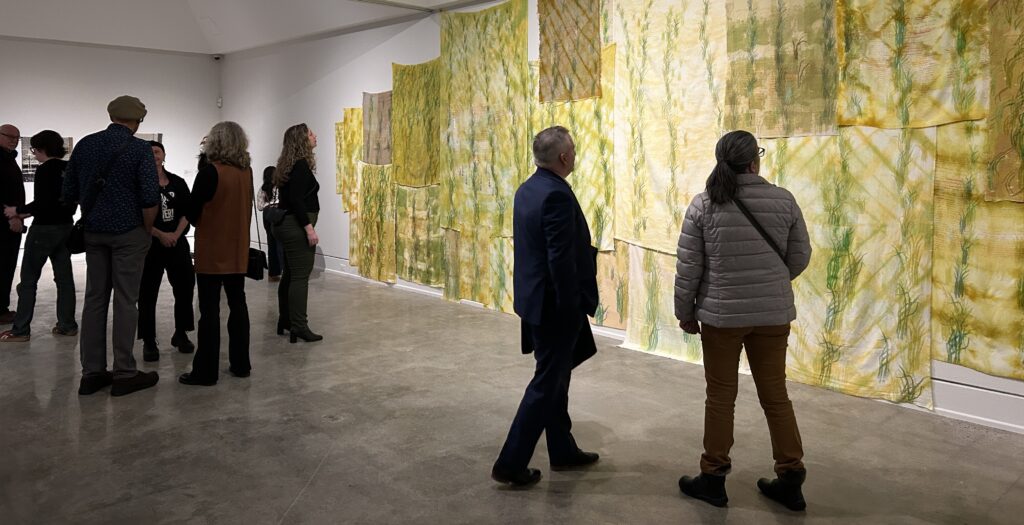
Familiar faces gathered around the spiralling stairwell at the centre, drinks in hand, circling the same conversation: the Nova Scotia government’s recent proposal to cut arts, culture, heritage, and tourism funding. Grant programs were reduced or eliminated. The artists, administrators, gallerists, and others in the room, whose livelihoods are threaded into the fabric of this province, felt the weight, along with a growing frustration at how little care the provincial government showed the sector. The exhibition brought a reminder of why their work mattered.
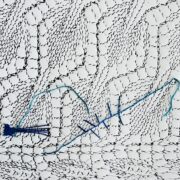
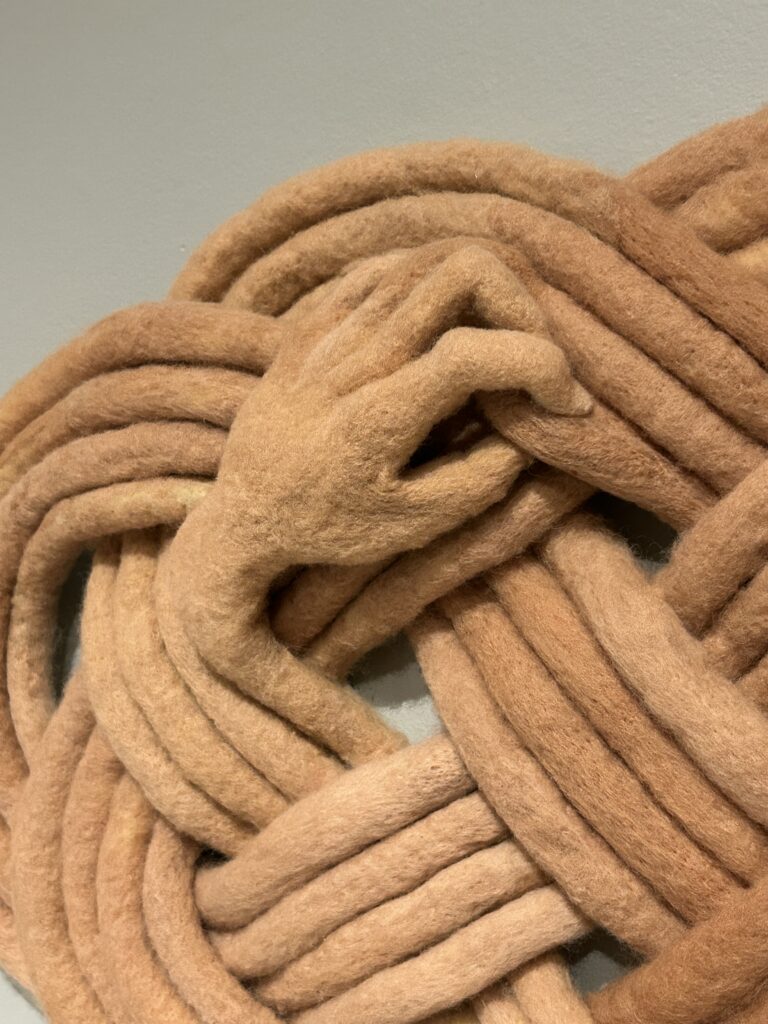
Descending the stairs, I was greeted by Alana Morouney’s Knotwork, where two hands emerge from the form, one at the upper left and the other at the lower right. Rather than meeting in a handshake, the two wool hands, dyed with knotweed, extend from the intertwined lines of the knot itself. Each hand appears to hold the structure in place, as if steadying the woven form that binds them together. It is Morouney’s homage to the market vendors, local makers, and the people who sustain New Brunswick through seasonal tourism and daily trade. The piece asks what holds a community together once the tourist season ends and the attention moves on.
I walked past Knotwork, past the other pieces on the walls and the crowds who adored them. Then Darlene Baker’s I Am Conflicted About This Relationship stood on its own: a silver gas tank covered in pink tones and floral decoration. The object is both nostalgic and uncomfortable. Baker shows her family’s gas station and auto repair shop as a space that shaped her early understanding of femininity, patriarchy, and ecological cost, experiences she absorbed long before she had the language to name them. The work holds the tenderness of what was alongside the damage beneath it, without resolving either into something easier.
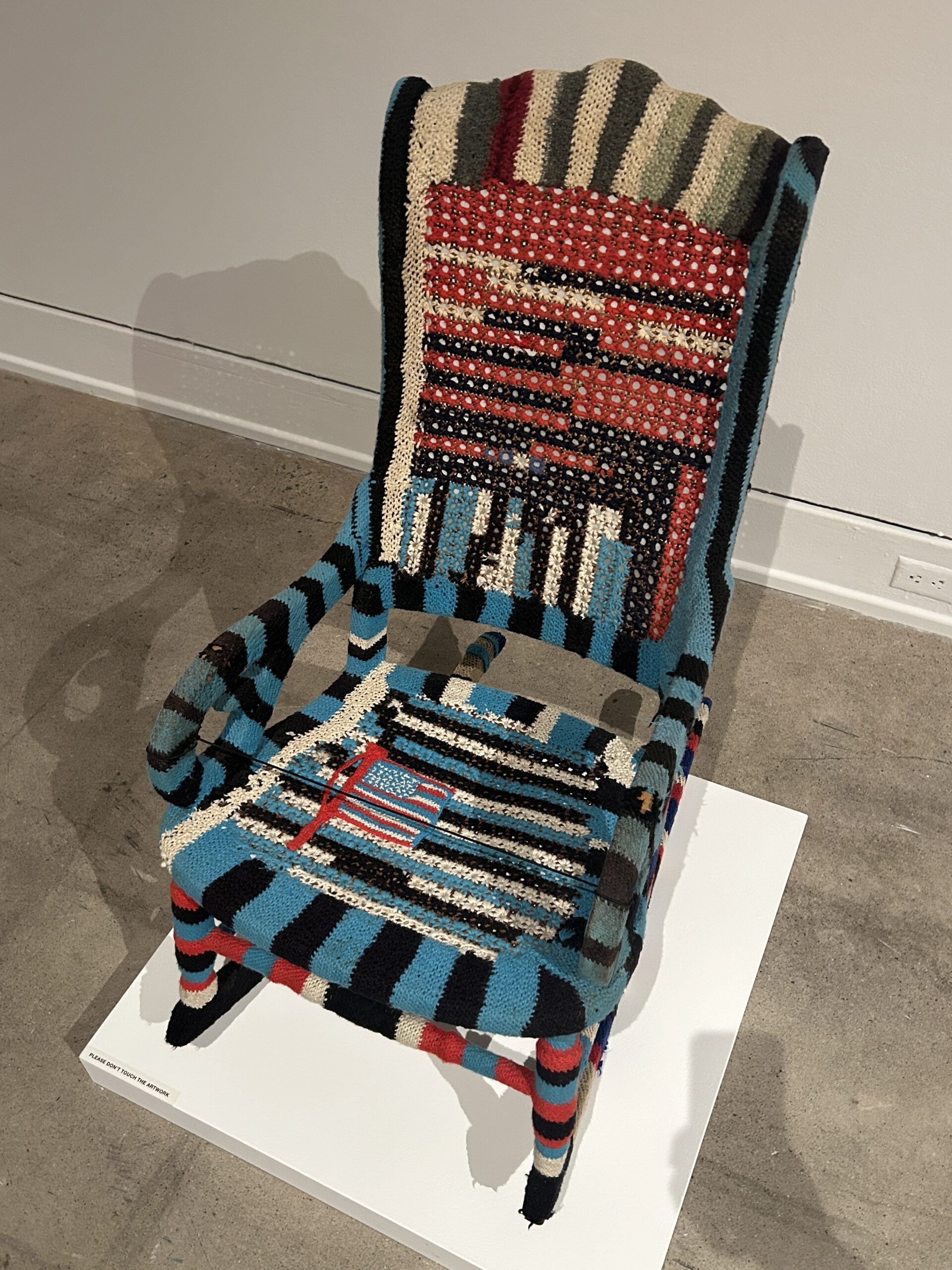
Across from the gas tank, another colourful work stood out: Albert Lohnes’s The Red, White, and Blue Crocheted Rocking Chair. Made sixty years ago, the piece could not have anticipated what the Canada–US relationship would look like now, but it did not need to. The knitted work covers and moulds itself to the chair’s frame, with the American flag woven into the seat. Some tensions, it turns out, have always been rocky.
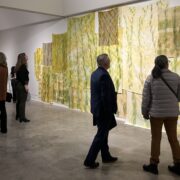
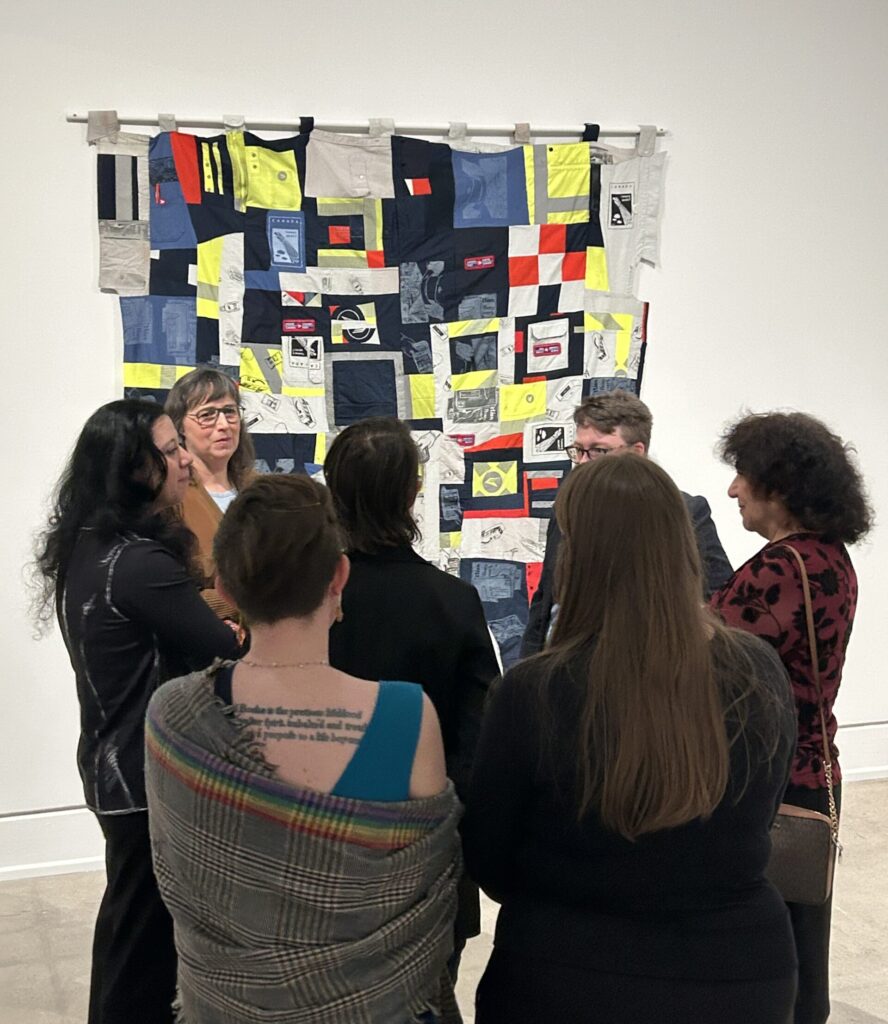
Next, I walked toward Portrait of the Artist as an Essential Worker by Hannah Genosko and Sarah Mosher. The work consists of two quilts made from uniforms the artists wore during the COVID-19 pandemic, one from Canada Post and the other from the NSLC. The garments hung on the gallery walls, documenting what traditional media and its sensational news cycles cannot by holding in place the anxiety, the daily risk, the labour of showing up. Frontline workers are often spoken about during crises and less often afterward. This work, along with the recent national postal strike, highlights the consequences of overlooking those who hold society together.
Past several more works, Oakley Wysote Gray’s Lapigot — Small Pox is where the exhibition’s weight gathered most intensely. A bodysuit stands draped with a Hudson’s Bay Company blanket, its famous red, yellow, and green stripes marred by bloodstains. Lacework across the fabric suggests the marks of smallpox rashes. Tears and slashes open at the torso and thighs. Gray, from Listuguj First Nation, made the piece as part of a collection titled Mei Eimotieg — we are still here. A fitting title for a work made in 2024, a year before the Hudson’s Bay Company declared bankruptcy after 355 years of operation. The blanket carries centuries of colonial history: the consequences of exploitation, disease transmission, and the displacement of Indigenous communities from their lands. Gray’s piece was already doing its work before the closing. Yet, the collapse of the institution does not erase its history; it just makes the stain more visible.

These five works, among seventeen, demonstrate what textiles have always done: archive the things that official records miss. Labour. Frontline life. Colonial harm. Generational knowledge is passed hand to hand, stitch by stitch, like a community refusing to let go of itself.
Divine timing or pure coincidence, the show opened at the right moment. For everyone in that room carrying uncertainty about what comes next, the works offered evidence of a long-enduring Maritime resilience that has always found ways to hold itself together and pass that knowledge on. Fabiyino lets the pieces breathe out the essence of preservation and resistance rooted in this place. What became clear is that the thread, regardless of how much it is pulled, stretched, or pressed from every direction, does not need permission to hold.