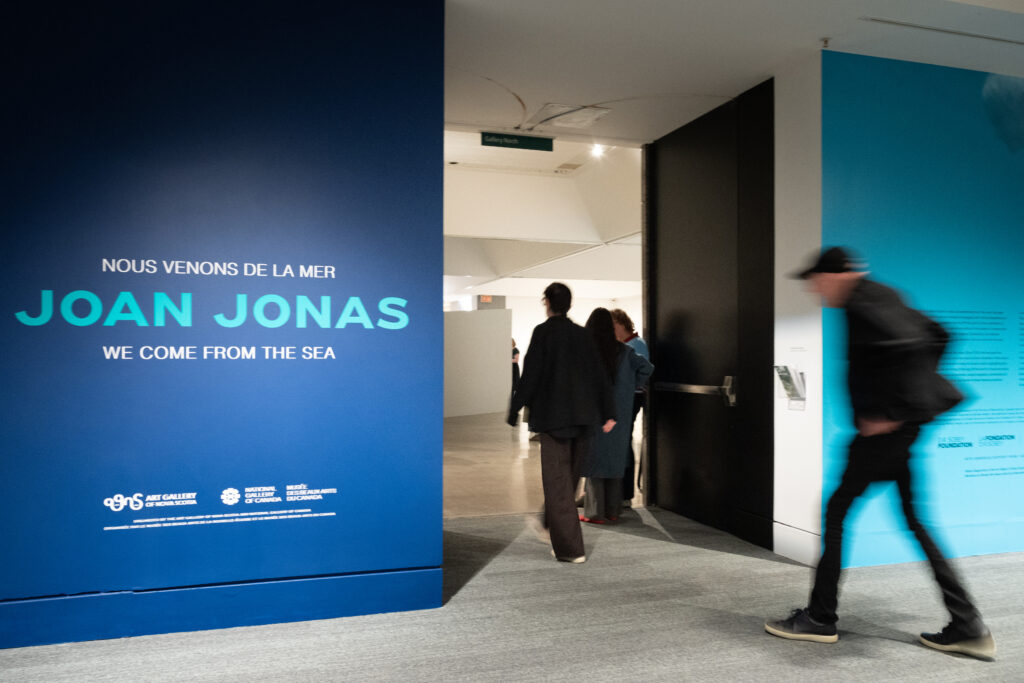
One must descend to reach Joan Jonas’s We Come From the Sea at the Art Gallery of Nova Scotia/Mi’kma’ki. Whether by design or happy coincidence, the exhibition (on view from June 13 to October 4, 2026) occupies the gallery’s lowest level. Visitors wind down a gently spiralling staircase before arriving at the entrance, a movement that suggests the curve of the nautilus shell, the curl of a tentacle, as though leaving the sunlit surface for deeper levels. Joan Jonas draws everything, even gallery stairwells, into her work.
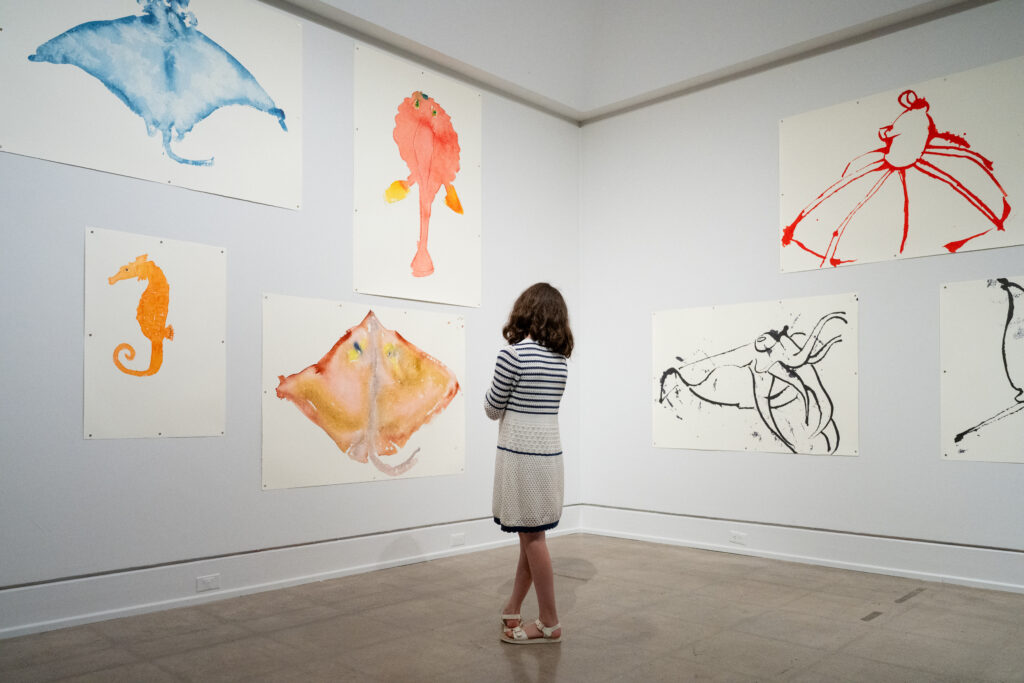
The first things to catch the eye are the large orange fish. Originally suspended as banners during the exhibition’s presentation at the Venice Biennale, the drawings now stretch across the gallery walls. Rendered in Jonas’s rapid hand, the fish recall the Ensō, the Zen circle, rendered in uninhibited brushstrokes that are said to emerge from a “no-mind” state, conveying the freedom of flow. The fish feel alive, not from any attempt at realism but because they are breaking containment of form, splashing outside of the lines. One can almost hear the smack of a wet brush on paper.
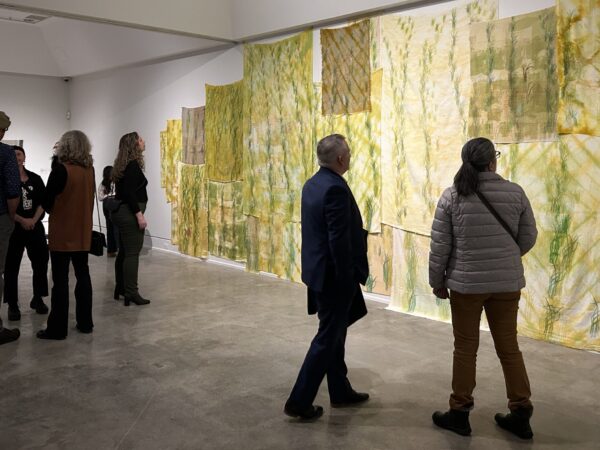
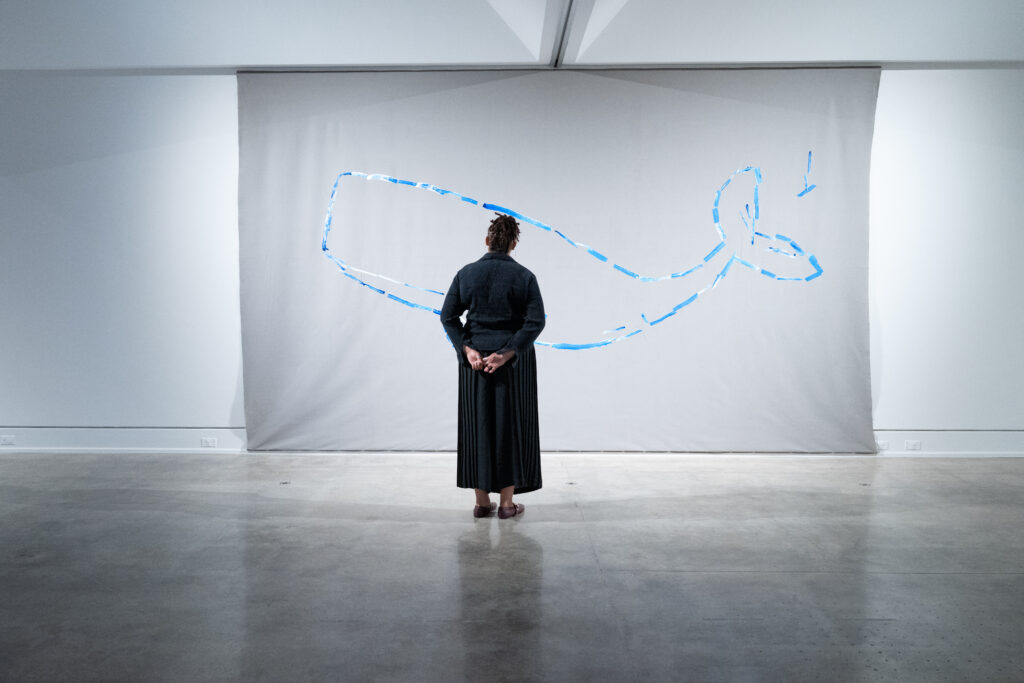
Passing through a threshold of colour I can only describe as “underwater-photography blue”—a blue that suggests infinite aquatic reaches—the exhibition opens into an environment of moving images, drawings, mirrors, sculptures, and theatre-like viewing boxes. Positioned within are two room-sized theatre boxes inviting visitors inside and two smaller wooden viewers. Sea creatures glide across projected bodies. Everywhere, drawing persists: on walls, on paper, and in the gestures of Jonas’s own filmed performances.
The instinct, at least for this reviewer, is to begin searching for labels. Anything to explain, to provide context. There are remarkably few. It soon becomes clear that this is not an exhibition meant to be consumed artwork by artwork but as a whole, operating as a single environment—an ecosystem—asking viewers to move through it slowly, allowing confluences between its parts to emerge. When I later mention this to co-curator David Diviney, he smiles in recognition.
“It operates as a singular work,” he says. “We invite people to enter the gallery space, immerse themselves in the installation, and experience it on their own terms.”
That trust in the gallery-goers is one of the exhibition’s defining qualities.
Rather than directing visitors toward a prescribed interpretation, We Come From the Sea emboldens the visitor’s intuition. Meanings accumulate, through repeated encounters with recurring images, gestures, sounds, and materials. Given the duration-based nature of the work, Diviney says, “It encourages people to spend time in the space and with each of the different elements. Along the way, a deeply personal experience begins to unfold.”
That unfolding has characterized Jonas’s practice for more than five decades. Widely recognized as one of the pioneers of performance and video art, the New York artist first emerged in the late sixties, when visual artists, dancers, filmmakers, and composers were working fluidly across disciplines. During an artist talk following the exhibition’s opening, Jonas recalled taking workshops with dancers because she’d never formally studied performance.
“I developed a way of moving in relation to a subject,” she said.
That emphasis on movement continues to shape her work today. Rather than illustrating and defining ideas, Jonas circles around them, approaching them from different angles through drawing, choreography, film, storytelling, mythology, sculpture, and sound. Each medium reveals something the others cannot; all are connected by the artist’s curiosity.
Cape Breton/Unama’ki has been foundational to that evolution. Jonas first travelled there in 1970 with a group of artists that included Richard Serra and Philip Glass, returning nearly every summer since. When Diviney remarked to her that the island has served such a significant part of both her life and her practice, her response was immediate: “I literally fell in love with it.”
The influence runs deeper than land- and seascape alone. Jonas has spoken often of her fascination with Gaelic traditions, ceilidhs (“kitchen parties”), Celtic poetry, local dance, and the rhythms of coastal life. These experiences became woven into an artistic vocabulary that refuses to separate human culture from the natural world.
That relationship—that symbiosis—ultimately led to Moving Off the Land II, the body of work from which We Come From the Sea emerges.
“I started out very simply,” Jonas explained. “I asked myself: How do I make a piece about the ocean, which is a vast subject? How do you start?”
Her answer is not to explain the ocean. It’s to change the way we relate to it. Consider the ways we discuss sea life, calling it “otherworldly” and the creatures therein “alien.” Jonas continually reminds us of how partial our own perception really is, how we set ourselves apart from the rest of the world. We’re wrong to do this, implies Jonas. Look at us with our finlike hands and our tentacle arms, these pieces (especially the video installations) seem to say, we really do come from the sea! In one section of the exhibition, fish, shells, and found objects sit within a thick rippled glass vitrine resembling an aquarium. They shimmer and change slightly as viewers move past them. Elsewhere, similarly rippled mirrors transform the gallery into an aquarium, rendering the visitors as though they were underwater. These strange sea-apes slip in and out of view. Even Jonas’s drawings resist stillness and completion. Their loose lines suggest fish without fully describing them, yet preserving something of their flitting movement and darting, quicksilver unpredictability. Everything in the show becomes slippery, hard to hold.
Marine biologist David Gruber became one of Jonas’s important collaborators while developing the project. “He deals with the perception of fish,” she said, “and I deal with perception as well.”
Gruber’s research explores forms of marine bioluminescence invisible to the human eye. “We can’t see the fish the way they see each other,” Jonas observed. “Through David’s lens you realize how bright it is down there and how colourful, but we can’t see that.”
The exhibition, in its own submerged way, asks what else remains beyond human perception. Artist and design educator Angela Henderson sees this concern running through Jonas’s entire practice. “I think she alters our perception,” Henderson told me at the exhibition opening. “She’s really skillful at asking us to look more closely at what we don’t see—or what we do see, for that matter.”
Rather than offering certainty, Henderson argues, Jonas invites viewers into a more demanding form of attention. “The viewer has to do a lot of work,” she says, “not necessarily to understand what’s happening, but to feel what’s happening.”
That distinction feels crucial. Much contemporary environmental art relies on urgency, statistics, or catastrophe. Jonas chooses to swim in another stream. Her work nods toward ecological precarity without becoming heavy-handed. It is less interested in persuading than in inviting sustained attention.
“She is paying tribute to the ocean, its creatures, the biodiversity, and delicate ecology,” Diviney explains. “On a certain level, the work is intended to raise awareness, but its core takeaway is the call to action—urging visitors to reflect on their own relationship with the sea.”
That invitation takes on a particularly moving form in the exhibition’s youngest participants. In the films, children perform, read, improvise, and move through imagined underwater worlds.
“The children will inherit this,” Jonas explained to Diviney at the artist talk. “I thought it was important for them to represent themselves in the work because they’re the ones who are going to inherit it.”
This statement lands with surprising force. The kids are not symbols of innocence or optimism. They’re collaborators. Jonas never asks them to perform predetermined roles. “I never tell them exactly what to do,” she explained. “I set up improvisational situations.”
Their presence reminds viewers that environmental stewardship extends across generations.
Rachel Carson’s spirit moves through the exhibition as well. Jonas dedicated the work to the pioneering marine biologist and author of Silent Spring, describing Carson as “a scientist, but also a poet in the way she wrote.”
Science and imagination are never opposing forces here. They coexist comfortably, just as mythology sits beside marine biology and performance beside drawing. Perhaps that is why We Come From the Sea feels so generous. It refuses easy conclusions.
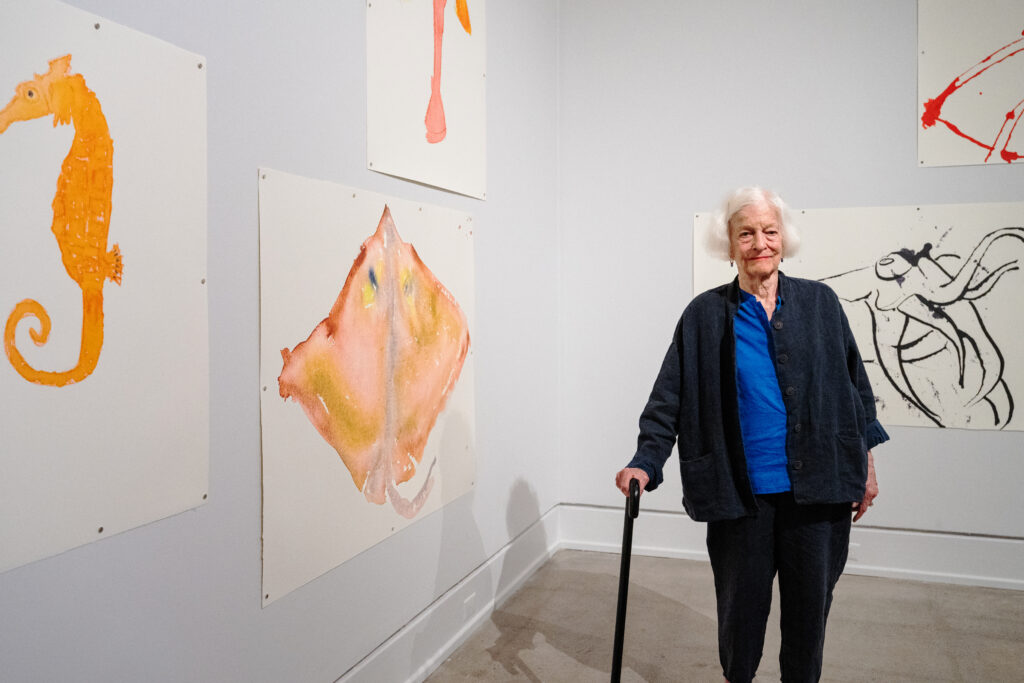
As Henderson observed, “You can’t just go to that exhibition and be an observer. Being a witness and being an observer are two very different things.” To witness requires patience and intuition. It requires lingering inside uncertainty. It asks something of us.
Before leaving the gallery, I found myself returning to one of the theatre boxes, watching the entire cycle of video clips, waiting for my favourite section. In the cycle, Jonas, in a long white coat and white trousers, moves in front of projected video images of underwater life. The clips play across Jonas and the screen behind her. My favourite clip features Jonas dwarfed by an underwater close-up of a seal and dancing with it. She moves, accommodating its bulbous calf-eyes and long whiskers, reacting to its corkscrewing turns, chasing after it, grasping and catching nothing. The seal-image slips through fingers, she can’t even catch hold of a fin. Its movements are fluid and nubile, hers are shaky and elderly. At first, the clip struck me as a practice in futility. She can’t possibly affect it, cannot really interact with the seal, cannot catch in her hands what she is pursuing, and yet…And yet, through her dance with the images flickering over her form and the screen, she does. She does change it. The scene takes on the drama of an artist losing control of her drawing, and it is a glory.