By Karin Cope
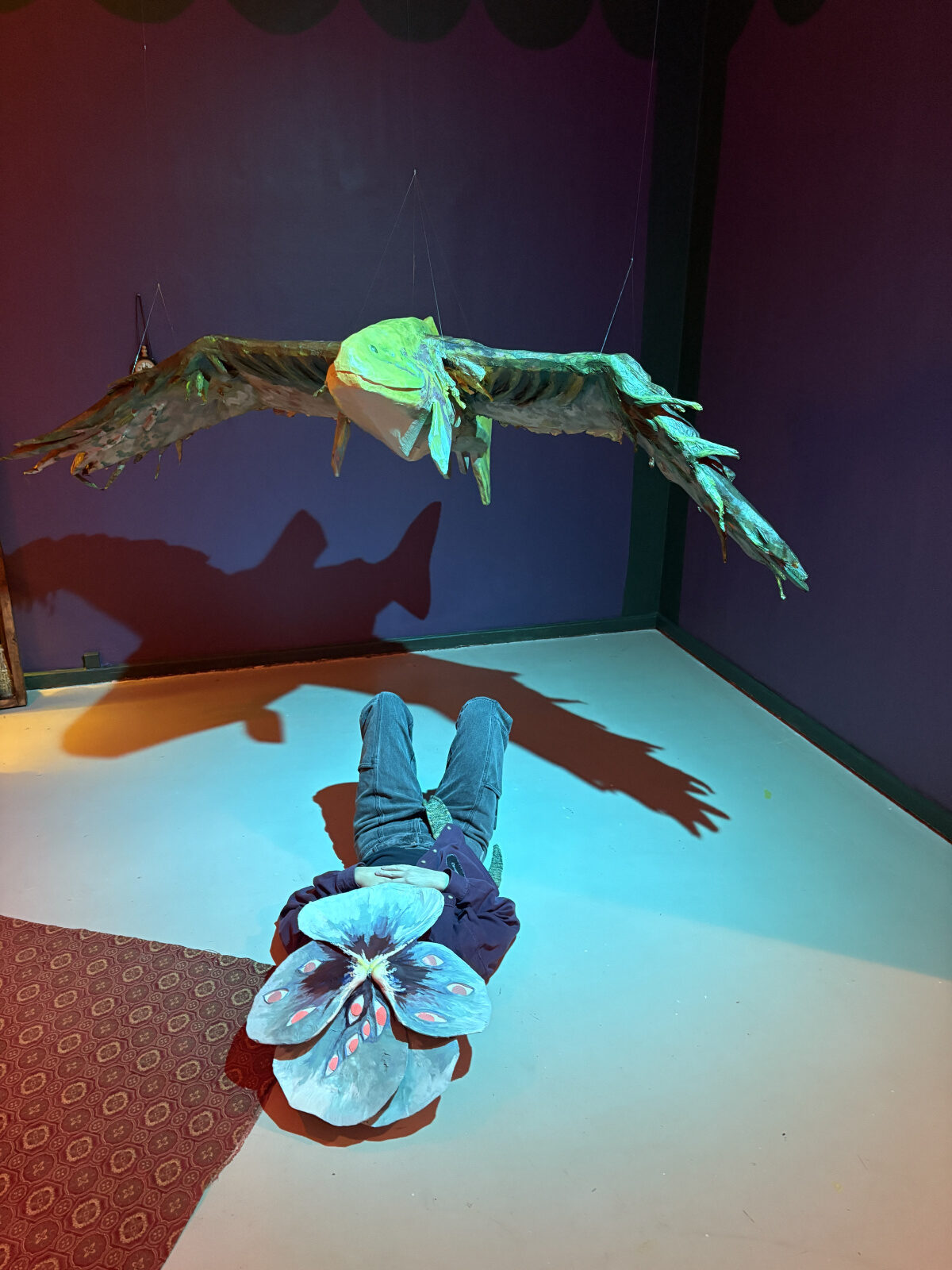
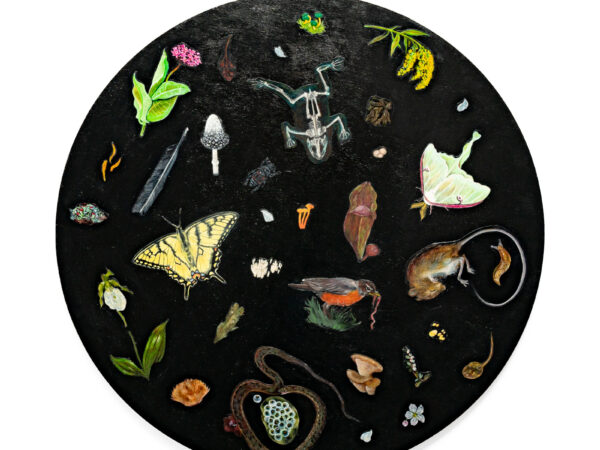
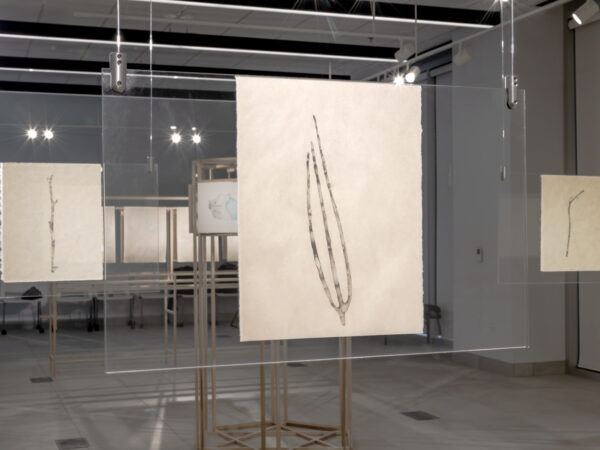
Two Pansies, a collaborative exhibition installed at Saint Mary’s University Art Gallery during the fall of 2025, featured colourful, whimsical, and deeply serious eco-feminist dialogues in paint, sculpture, video, and performance by two emerging queer artists, Autumn Star and Shay Donovan. An expansive show filled with paired paintings of uncanny figures in luscious colours, performances in animal and flower costumes, and moving, human-sized snail, fish, bird, and spider sculptural forms, Two Pansies makes an argument that queer and trans bodily change is about more than “sex,” “gender,” or “human” morphologies and relationships. It is also about the beauty of emergence and the ways our relationships with one another and the non-human world inspire, move, reveal, and tether us in “laughter, whimsy, shame, and love,” as the Two Pansies video puts it.
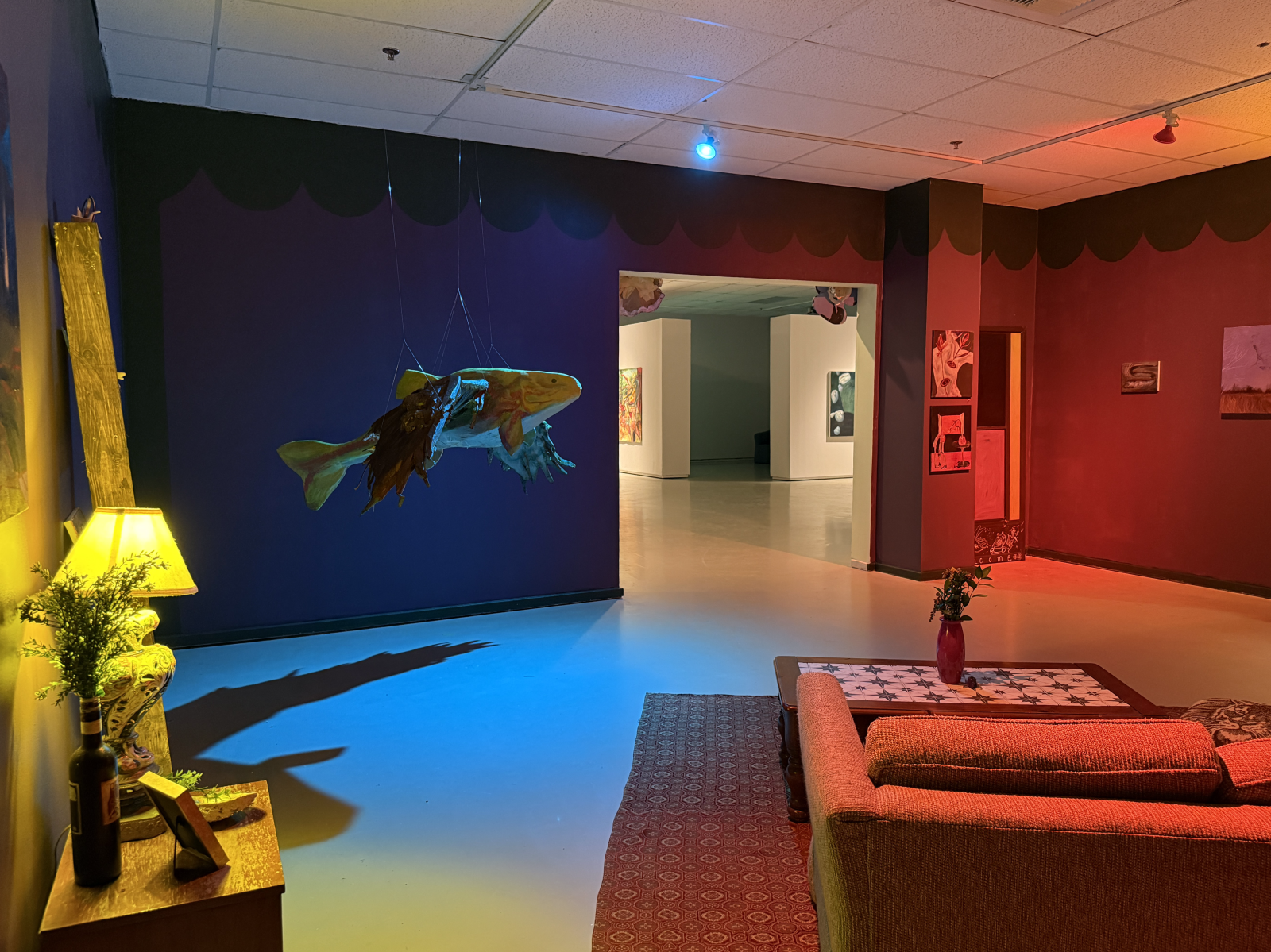
Characterizing their show as a “tender archive” of “strange strangers” or emergent beings, artists Shay Donovan and Autumn Star speak of their work as an effort to help nascent forms they encounter while living and making “find their shape” and “come to be at home.” Costumed as lobsters, bees, owls, pansies, or jackalopes, they animate animal and plant stories they have “collected along the way.” Furnished with materials from their own homes and decorated with drafts of paintings found in the show, they also provide access to a domestic space or “home” for the Two Pansies in a side room of the gallery.
Across their performances, Donovan and Star centre care, humour, and fragmentary narrative as methodologies, engaging viewers in the intimate rhythms of a generous and multiple queer life. They also show how colour may function as both camouflage and highlight, offering expansive understandings of what painting is or could be and asking us to look and listen more closely to making and the living world as sources of new queer imaginings.
Full disclosure: As a director of the NSCAD MFA program during part of the time both Donovan and Star were enrolled, I know them well and visited their studios while they were developing this work. I met them in Kjipuktuk/Halifax in late November 2025 to discuss critical aspects of the exhibition.
KARIN COPE: Let’s talk about your title. It nods toward queer histories and iconographies, including the etymological history of the pansy, from its fifteenth-century roots in the French pensée to its early twentieth-century use as a term meaning “effeminate.” How did you find your title, and which came first, the characters or the title?
SHAY DONOVAN: The name for the show came first. Alongside the rich etymological history of the word, we really enjoyed reclaiming the word “pansy” from its modern usage and transforming it into these pansy characters. Because why can’t a being be effeminate and delicate but also powerful and formidable?
KC: Some of the work appears side by side, while other elements, like the film, the Birdfish sculpture, and the Pansies’ “home,” feel fully collaborative. How did your collaboration begin, and how is working together different from working alone?
AUTUMN STAR: Shay and I have been close in proximity in our creative spaces for a few years now, so working together was a natural evolution. We met during our time in the MFA at NSCAD, where we were assigned studios next to each other. Early on, while I was making a giant snail sculpture, we learned that we both have a shared enthusiasm for bugs. I’ve never seen anyone’s eyes light up as much as Shay’s did while talking about cicadas, so we co-curated a group show called Swarm, all about the insights of insects. Two Pansies was another chance to combine some of our headspace to create things that I doubt either of us would have manifested alone.
KC: What is the role of the house, or “pansy safe space,” in relation to the film? You’ve described the show as a “tender archive.” How does the house function as a space of intimacy and care?
AS: The installation for the Pansies’ home functions as an invitation to enter a strange habitat and helped us explore tensions between interior and exterior in queer space. What is shown? What is concealed? I wonder about the fragility of queer archives and efforts at preservation. If you wanted to preserve a pansy for display, you would have to press it in glass, but that estranges its velvety textures and puts them at risk of shattering. A more private option might be pressing the flower between the pages of a book, but then who else gets to see it? The living room and the film are a living archive of the Two Pansies in this moment, filled with art, love, joy, and a gigantic Birdfish.
KC: There is great physicality in this work, from the human and more-than-human scale of the pieces to the gestural marks they record, the precarious balance of the sculptures, and the whole-body performances in the film. You also posit a merging of bodies, species, and genders, visible in the snail sculptures, the Birdfish, and the animal and plant characters in the film, as well as in the melding of plant, animal, mineral, and human forms in your paintings. Can you talk about the vision of the world these interlacings propose, why it matters to see the world, as Emily Dickinson would have it, “slant,” and what kinds of ecological care shape this work in terms of themes and materials?
AS: Using the whole body to create a piece as big or slightly larger than life takes a lot of endurance; we want that energy to bleed into the work. As for the merging of plants, animals, and spirited bodies, these conjoined hybrids show that it takes repeated hovering around the edge of something to get to know it and to see just how circular our connections to life are. And of course, as to materials, we’re recycling all the time!
SD: I love the space between the slants, the little crevices we can carve out to make room for identity that isn’t one thing or the other. In the film, I moved from depicting entities through painting to embodying them on camera. I had to give myself permission to inhabit the character rather than act as a witness.
KC: Talk to me about colour and materials. Do they build worlds? You’ve described your process as helping these emergences find their shape. Is this queer birth?
AS: Colour is a guiding companion for me. It can be patient when figuring out a composition or rowdy and certain about where the eye should travel. Colours rubbing against each other create visual conversations. I feel like Shay and I have distinct palettes that speak a similar language with different accents.
SD: There comes a time when the material takes over and I’m no longer the conductor but a conduit. If I don’t let that switch happen, the piece feels unresolved. Colour in my paintings is mostly intuitive. Sometimes it comes from memory, but it helps build the world of the work. I imagine what’s happening out of frame as a continuation of what’s visible. Is that a queer birth? Maybe.
KC: In the video, you describe shared affects as “laughter, whimsy, shame, and love.” Why does this particular assemblage matter?
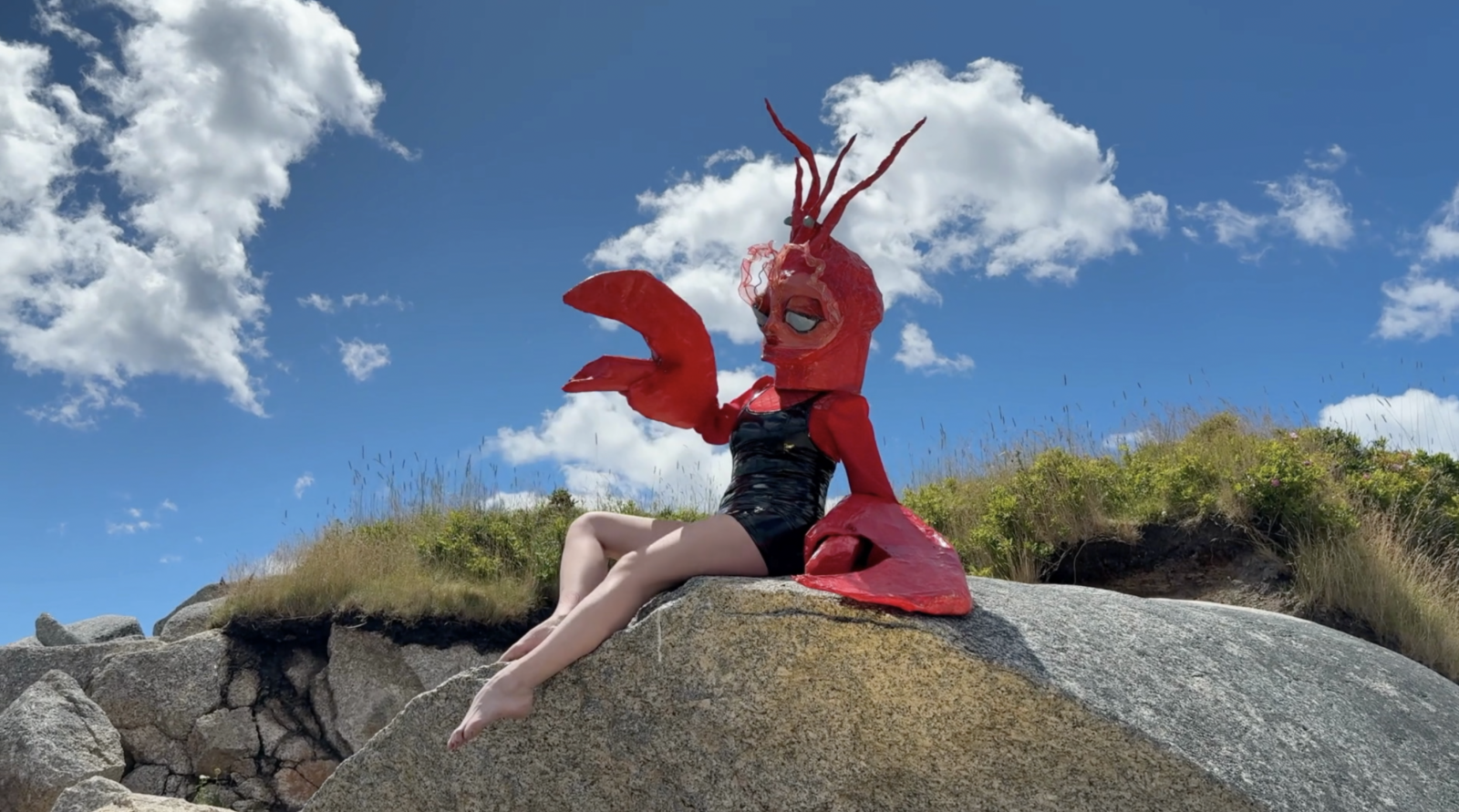
SD: Whimsy often gets mischaracterized as frivolous, but it can be a huge source of joy. We didn’t want to take ourselves too seriously, and letting whimsy guide some decisions left room to breathe and have fun. Laughter and whimsy feel internal, while shame and love are often projected from outside. Together, they feel like a common queer experience.
KC: How do you begin a project? How do you know you’re onto something?
AS: Sometimes a piece you think is legless ends up with three legs and six arms. Other times you think something is sturdy and it turns into a fish with wings. We tend to let our hands do the heavy lifting and let the concept follow. Embracing fluidity is important.
SD: It’s hard to tell when something starts walking on its own. Sometimes I don’t know until it’s already out the door and teaching me something.
For example, we’ve been asked a lot about the collaborative Birdfish. It was my first time working on a sculpture that large and alongside someone else. It was inspired by watching ospreys near Lunenburg catch fish. The way they carry fish, held forward and parallel to their bodies, looks almost as if the fish has wings. In a last embrace, the fish is thrust into a different realm. I wonder how they experience that brief hybridity and what it would look like for the fish to have control over that journey.
KC: What have you learned from working together? Would you do it again? What’s next?
SD & AS: This is just a start. We fuel each other with our ambition. It’s exciting to work alongside someone who shares the feeling that there is more to explore. There will be collaborations in our future, and this isn’t the last you’ll see of the Two Pansies.