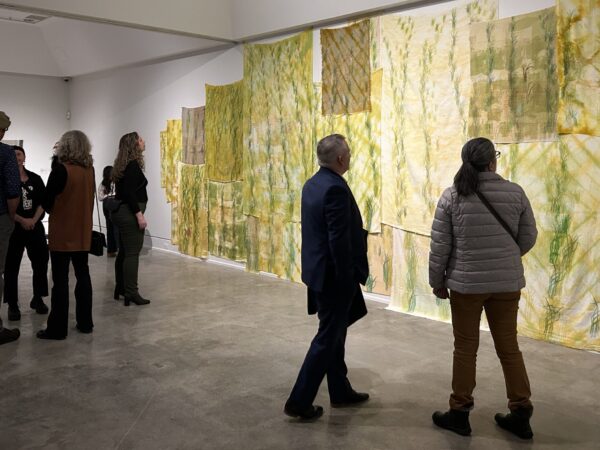
Walking into the Treaty Space Gallery at Nova Scotia College of Art and Design University on a bitter cold February morning I smell the lingering sage from the exhibition opening of Amalkewinu’k from the previous night. For the public portion of the opening, Michelle Peters sang a Mi’kmaq song, and curators Aaron Prosper and Mackenzie Pardy shared a few words to welcome everyone to the Victoria-era elegance of the new Treaty Space Gallery exhibition space.
In the fall of 2024, the Treaty Space Gallery, whose mandate is to highlight artwork that responds to the UN’s declaration of the Decade of Indigenous Languages, themes of cultural revitalization, and notions of treaty, relocated from NSCAD’s Port Campus to 1887 Granville Street, a former bridal shop. The new location is part NSCAD’s Fountain Campus, formerly the Victoria School of Art and Design, founded in 1887 by Anna Leonowens, Mrs. Jeremiah Kenny, and sisters Ella and Eliza Ritchey to commemorate Queen Victoria’s Golden Jubilee. With wood floors, white walls, and Roman pillars, the Treaty Space Gallery is a gathering space for Indigenous students and welcomes all treaty people who come together in community.
Amalkewinu’k (The Dancers), curated by Prosper and Pardy, which ran in Halifax from February 4 to 14, 2025, illustrates the evolution of Mi’kmaw regalia by inviting viewers into an exhibition space that features studio portraits of Mi’kmaw community members in regalia, black-and-white archival images, and three pieces of regalia–a beaded cap, a headdress, and a Mi’kmaw jacket. Amalkewinu’k opens at Acadia University in fall 2025 and runs throughout October in celebration of Mi’kmaq History Month. The exhibition will also open at StFX Art Gallery in fall 2026 as part of the fiftieth anniversary of the gallery.
Amalkewinu’k is the vision of curators Prosper, an L’nu artist and health care professional from Eskasoni First Nation, and Pardy, a photojournalist and documentary photographer, and is a collaborative community project honouring the transformation of Mi’kmaw regalia.
Presenting distinctively Mi’kmaw regalia through portraiture is central to the exhibition. Keeping the focus solely on Mi’kmaw regalia challenges misconceptions and pan-Indigeneity, honours Mi’kmaw artistic heritage, and celebrates past and present community artists, including L’nu Ancestors Once Known, Mi’kmaw youth like Rory Meuse of Membertou First Nation, and Elders like renowned author and educator Dr. Marie Battiste of Potlotek First Nation.
“The use of ‘L’nu Ancestor Once Known’ was quite intentional on our part and a bit of a critique of museum and art collections. I first saw this practice at the National Art Gallery, but I believe it might have its origins at the AGO,” says Prosper. “Basically, in many historical collections the Indigenous artist or persons represented consistently come up as ‘Unknown,’ but if a non-Indigenous person is connected to a piece—the photographer, collector, etc. —their name is known or stated.”
The intention behind the label goes deeper and opens a critique of colonial curatorial practices. As a form of Indigenous storytelling, these details are important as they offer insight into community connections, the artistic legacy of the regalia makers, and the important reciprocal relationships. It also allows for different ways to engage with the art maker and to understand who are the people being depicted in the photographs and who are their community connections. It also invites viewers to build a relationship with the L’nu Ancestor Once Known and opens up the possibility that their names may be recovered.
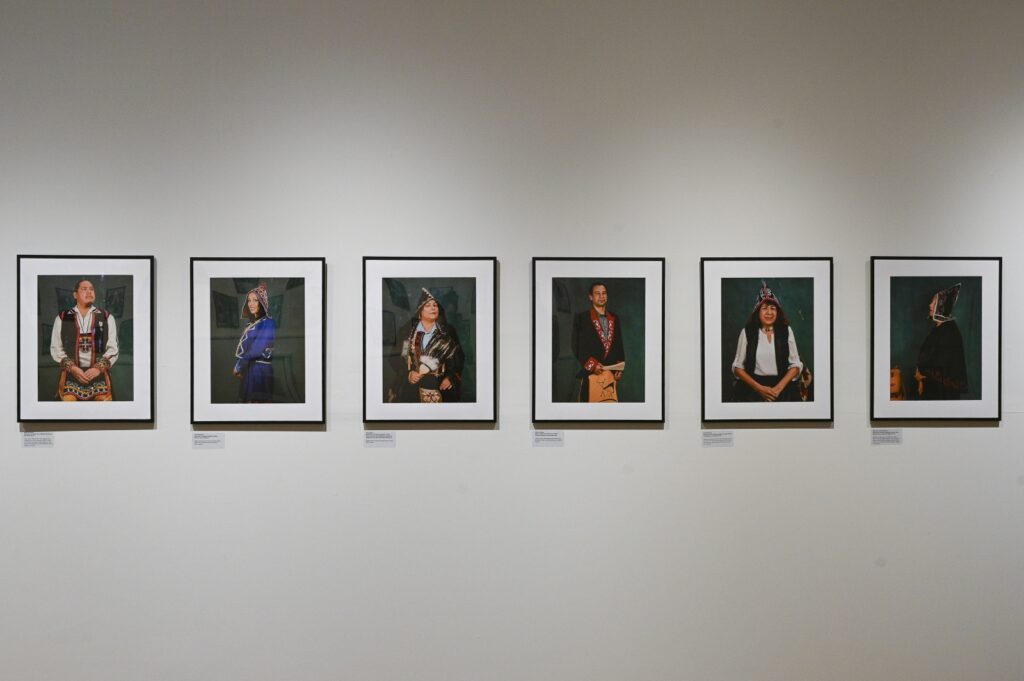
A wall of contemporary, full-colour portraits by Pardy features Mi’kmaw community members from the young to Elders and Matriarchs. Jacoby Battiste-Jadis of Eskasoni First Nation is wearing regalia made by his mother, Kate Jadis, and a feather cap made by Jennifer Denny with feathers gifted by his grandparents Marie Battiste and Sakej Henderson. Wyonna Bernard of Abegweit First Nation is wearing cuffs made by Mary-Jo Isaac, cap, skirt, cape, and leggings made by Ingrid Peters (gifted by Lisa Levi), and a pin by Mi’kmaw artist Melissa Peter-Paul, also from Abegweit First Nation. Michael R. Denny of Eskasoni First Nation is wearing a vest made by Melissa Peter-Paul, leggings made by Madonna Johnson, moccasins made by Nicole Travers, cuffs and aprons made by Mary Jo Isaac, a shirt made by Georgina Doucette, and a medallion created by Washonti:io Jacobs. Elders include Dr. Marie Battiste, who is wearing a jacket, skirt, and peaked cap made and beaded by Ingrid Brooks with alterations by Nina Kent; Karen Bernard, of We’koqmaq First Nation, a well-respected women’s peaked cap workshop facilitator, who is wearing a peaked cap she made herself; and Dr. Lorraine Whitman, of Glooscap First Nation, who is wearing a peaked cap passed down by Aunt Edith Peters, which was passed down to her by her grandmother (a Millbrook band member) and a beaded cape made by the wife of Noel Knockwood and is carrying baskets made by Frank Meuse.
In the didactic material for Amalkewinu’k’s, Dr. Roger Lewis, curator of Mi’kmaw Cultural Heritage at the Nova Scotia Museum, writes: “When looking at Mi’kmaw regalia, like other cultural belongings, keep in mind the ingenuity of the artists. In a changing and evolving world, they mastered the use of other materials in their art to a point where it remains distinctively Mi’kmaw. So, it therefore is more than a craft as it was often portrayed—especially with the Indian Affairs movement to market it as such. It evolves today, and that is seen in the work of contemporary artists. Things were and are made with thought and purpose.”
Lewis and Michelle Sylliboy, a multidisciplinary L’nu artist, are advisors to Prosper and Pardy, and they continue to work together on Amalkewinu’k, which is layered with stories and continues to evolve. As the storytelling aspect of the exhibition continues, the exhibition will likely be mounted in other gallery spaces in the future.
“The storytelling that came with how they presented their personal regalia was evident,” says Prosper. “Storytelling also came out in community member reactions to the historical images. The stories involved the regalia itself or things they were reminded of when talking about their regalia, and really everything in between.”
Across from the contemporary colour portraits of Mi’kmaw community members, Amalkewinu’k also features a wall of black-and-white archival images from the Nova Scotia Museum. One of the photographs, “Queen Victoria’s Diamond Jubilee (1897),” features a group of prominent Mi’kmaw community members who attended the celebrations for Queen Victoria’s Diamond Jubilee. Viewing the 1897 photograph in the former Victoria School of Art and Design feels like a full-circle experience, both marking, as they do, the same historic event.
One of the most striking images is a black-and-white portrait of Molly Musie from the mid-nineteenth century, taken in Annapolis Royal, Nova Scotia, which is considered the earliest known portrait of a Mi’kmaw person depicted in a photographic process. While her birth and death dates are unknown, the didactic explains: “Molly Muise (the name was originally the French ‘Mius’ and is now spelled Meuse and Muse as well) is wearing a peaked cap with double-curve beadwork, a dark shirt, a short jacket with darker cuffs, over which she apparently has draped a second short jacket, its sleeves pulled inside, as a capelet. Her traditional dress with the large fold at the top is held up by suspenders with ornamental tabs. In her hands, she seems to be clutching a white handkerchief.”
From the first known black-and-white, archival image of a Mi’kmaw person to Pardy’s contemporary portraits of Mi’kmaw community members, Amalkewinu’k is a stunning exhibition connecting past, present and future generations of Mi’kmaw through regalia and culture.