
Mapping Black Resilience: Three Perspectives at Dalhousie Art Gallery, which ran from February 4 until May 4, 2025, is an exhibition in three acts, which independently, yet in tandem, reconsider archival material and its role in the documenting and redocumenting of Black identity. The exhibition explores personal and collective experiences as archival documentation of Black resilience and history and allows the works to become documents for the future.
I was initially attracted to visiting the exhibition based on prior interest in the work of Theaster Gates. I had first heard about his work with the Stony Island Arts Bank. The bank was built in 1923 on the South Side of Chicago and operated as such until the 1980s. After sitting vacant for decades, it was reopened in 2015 as a hybrid gallery, media archive, library, and community centre. The building houses multiple archival collections such as personal vinyls in the collection of Frankie Knuckles, known as the godfather of house music, and the Edward J. Williams Collection of “negrobilia,” approximately four thousand objects that make use of stereotypical images of Black people, now out of public circulation but available as a reminder of history and the need for ongoing analysis. I approached the exhibition with notions of archival agency hovering in the back of my mind.

The first work I encountered was Souvenir by Chantal Gibson, part of Down Home: Portraits of Resilience curated by Fabiyino Germain-Bajowa. This work explores the “collective historical experience of Blackness” through souvenir spoons and the act of reproduction of an image. Souvenir spoons tend to bear imagery of constructed statehood and reify colonial narratives. Gibson has blacked out the spoons, evoking a myriad of different readings for the work. White’s outlines of the painted spoons, presented in an artist’s book, hover like ghosts, referring back to the colonial imagery revealed in the texture of the blacked-out spoons. The installation is neighboured by a video in which Gibson spotlights the notion of the “Black wench.” The term originated in The Stepsure Letters (1821–1823) by Thomas McCulloch, a book that is widely considered to be a cornerstone of Canadian satire. Gibson calls into question the “distortions that become entrenched in culture over time.”
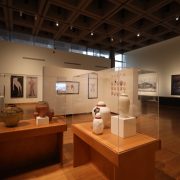
Walking through the gallery, I pass by the library tucked away in the corner of the space. I am greeted by images of splintwood basketry from Nova Scotia and Gee’s Bend quilts from Alabama, craft techniques, traditions, and objects as archives of the communities that made them. From the library I walk to another space containing tools of memory.
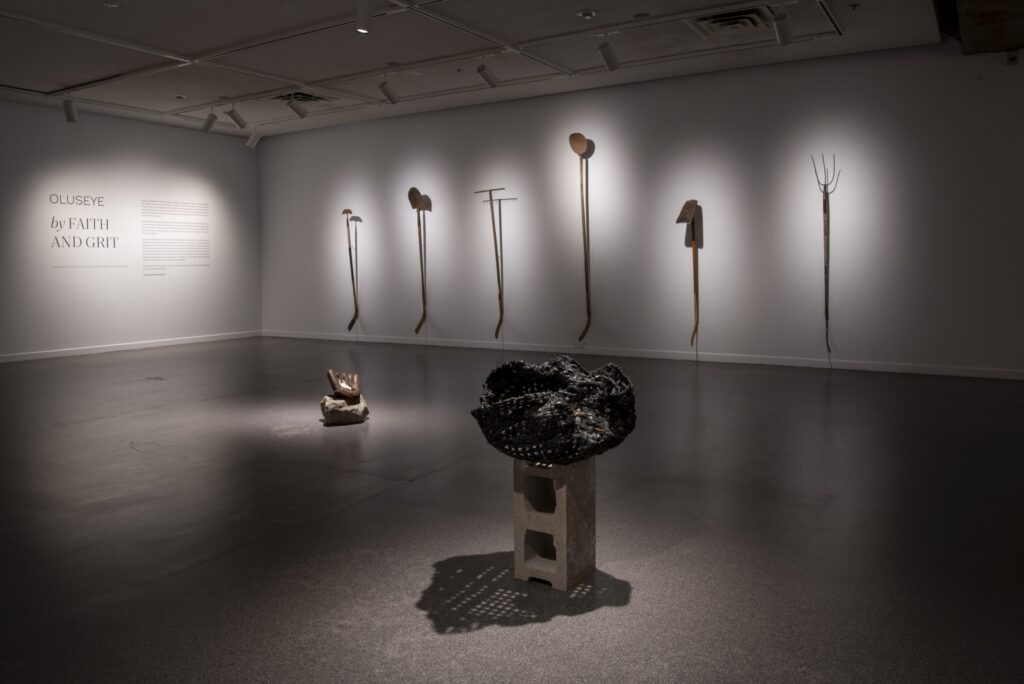
Oluseye: By Faith and Grit, curated by Pamela Edmonds, weaves “a tapestry of Blackness in Canada” with objects that the artist refers to as “diasporic debris.” Through objects tied to labour, Oluseye, a Nigerian-Canadian artist, highlights stories of Black rurality. By bringing forth the basketry of Edith Clayton from the twentieth century and photographs of contemporary Black farmers from the twenty-first, Oluseye bridges narratives of “endurance and legacy.” As calluses on a labourer’s hands tell a story, so do the tools that made them.
Meandering through the gallery space, I have arrived back to Down Home: Portraits of Resilience and its works that harness “alternative archival forms.” Nylon stockings and school photos are used in Rebecca Fisk’s work Confessions of an Invisible Sister to bring forth complexities of race, identity, and colourism in the Black community. By using an array of shades of nylon stockings, ranging from eggshell to deep ebony, Fisk calls into question the arbitrariness of damaging prejudices experienced by Afro-diasporic people. Fisk uses her childhood school photos, material from her personal archive, to invite the audience to reflect on the pressures to conform and the emotional toll of discrimination.
The painting The Faith Catchers by Justin Augustine shows two young men in front of New Horizons Baptist Church in the North End of Halifax. Augustine’s paintings often depict figures in landscapes reminiscent of Dominica, where the artist was born, and Nova Scotia, where he emigrated in his youth. His work explores how surroundings influence identities and the depiction of local landmarks works to sustain “diasporic knowledge, sentiment, and cultural legacy.”
I then enter a dark screening room. I am lulled by the familiar tune of “Amazing Grace,” but it’s different from any other time I’ve heard it. Theaster Gates: Billy Sings Amazing Grace is a hypnotic meditation on “one of the most enduring hymns in the English-speaking world.” Vibrating riffs draw me in, stretched out and chopped apart. Baring teeth, sounding out every single micro vocal, and trying out words in every possible way. Repeating words, rhythms, sounds as if searching for hidden meanings whilst also uncovering new translations of the lyrics, almost threadbare from years of wear. Steely drum clangs, liquid saxophone trills, and clacking sticks fill the room with hypnotic energy like an ecstatic dance. Every last drop is squeezed from the song.
In the video work, Theaster Gates and his musical ensemble The Black Monks rehearse the song with soul singer Billy Furston. The song, as an archival document of Black redemption and emancipation, is reappropriated as a meditation through drawn-out riffs and repeated rhythms, feeling out every single note and story that each word contains. Forston’s voice “reimagines grace as a continual, evolving process—realized through collective effort, community, and the pursuit of redemption.”
The three-part exhibition Mapping Black Resilience: Three Perspectives at Dalhousie Art Gallery offers alternate practices to archiving and documenting history. Most histories are embedded into daily lives, and the exhibition reveals stories that have always been there but haven’t always been recognized in colonial structures. The exhibition becomes an archive of its own, an archive of resilience.



Leave a Reply