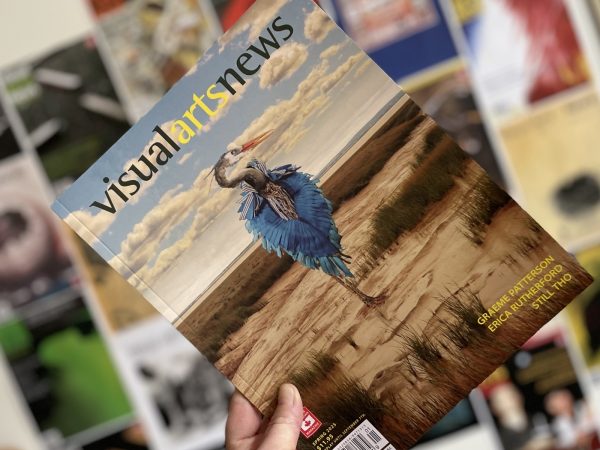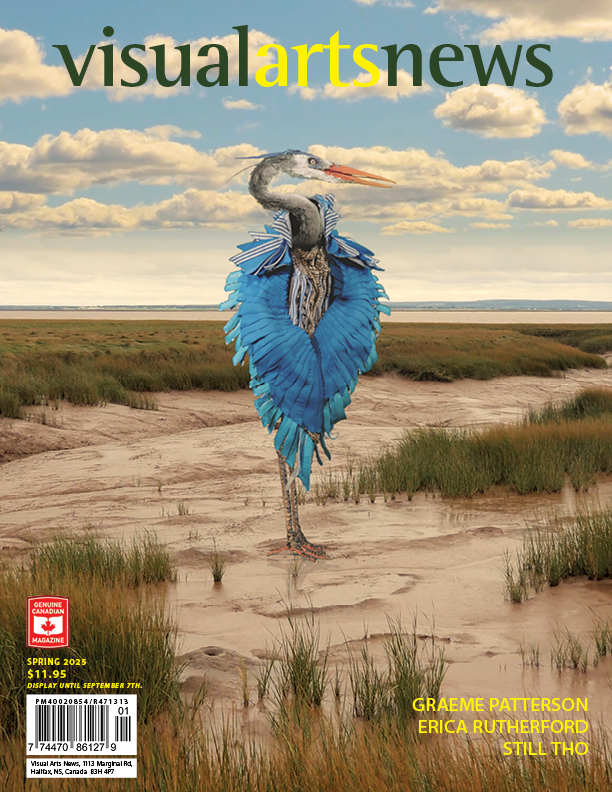
The cover of the current issue

Current Issue: Summer 2013

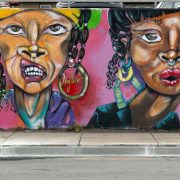
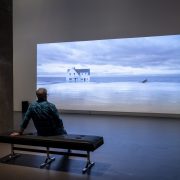
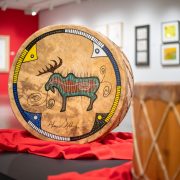
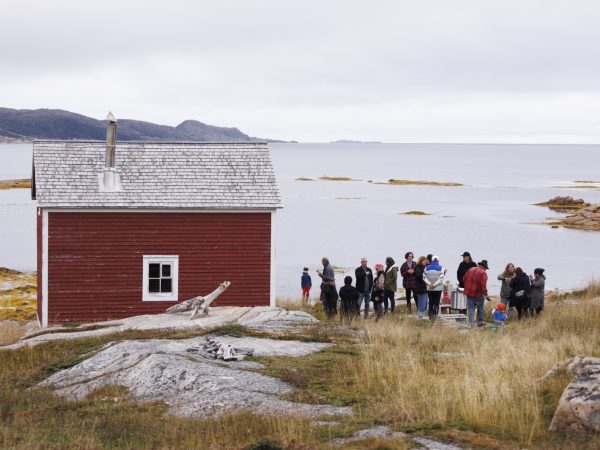
Robyn Moody animates forbidden knowledge
Chris Foster provokes our escapist tendencies
Darren Emenau picks up where nature ends
Take a peek inside!

A wolf in sheep's clothing

A wolf in sheep’s clothing

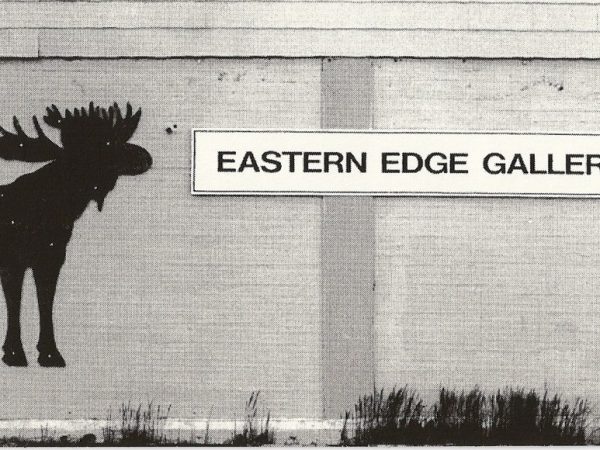
Eastern Edge Gallery, St. John`s, NL. December 15, 2012 – February 9, 2013 Halifax-based artist Chris Foster’s Frontiers in Real Estate explores contradictory themes of civilization—its fear stories, misguided good intentions and self-indulgent sincerities. Foster’s dark humour is...
Will Robinson's brutalist inspiration

Will Robinson’s brutalist inspiration

Visual Arts News catches up with Will Robinson during his recent residency in Dalhousie University's Killam Memorial Library. Robinson discusses his latest project—translating the surface of a building into song.
From Melbourne to the Bay of Fundy

From Melbourne to the Bay of Fundy

James Geurts isn’t your typical landscape artist. Living, creating and surfing in Melbourne, Australia, it’s no wonder he’s developed an affinity for the great outdoors.
Chasing Their Shadows

Chasing Their Shadows

I pulled up to the Grand Manan Island Art Gallery on my way to Deep Cove for another swim in the Bay of Fundy. I’ve braved the foot-numbing surf for the past two days, and my legs are...
Exhibition Listings
Focus on Photography

Focus on Photography

Rémi Belliveau, Marika Drolet-Ferguson, Julie Thibault-Forgues, Thaddeus Holownia, Mathieu Léger, Aaron McKenzie Fraser, and Blake Michel Morin

Focus on photography is a group exhibition curated by Annie France Noël. The exhibition looks at manifestations and uses of photography in contemporary art practices, featuring work by a mix of emerging and established artists.

Hortus siccus

Hortus siccus

“Hortus siccus” is the latin name for Herbarium. It was a scientific recollection and desiccation of living plants’ specimens. This exhibition is a poetic gardener’s chronicle of Ilaria Facchin’s artistic residency at Ross Creek. Vegetal strolls through symbols and myths. A breathing installation, with small botanic pencil drawings; 3D paper hand cuts; poetic and sound fragments and photos; a cycle of atmospheric piano improvisations and performances. The aim of this exhibition is to come close to the nature, its fine meaning and frail rebirths in our present times; to capture the emotions of spectators with simple natural details.

Cadenza

Cadenza

Cadenza is a collaborative project by artists Don Andrus and Jinny Yu. The two artists created murals based on an 18th century mural by Giovanni Battista Tiepolo. Each mural is 5 feet by 44 feet long. Instead of being an homage to Tiepolo or the history of painting, Cadenza is an inquiry into the nature of painting today and their respective studio practices.


The title Cadenza comes from a term in music referring to improvisations within a scored piece of music. “It is a dialogue on the walls,” as the exhibit’s curator, Ihor Holubizky, has put it. Yu and Andrus both create “their own particular variation on Tiepolo’s mural.”

100 Canadians

100 Canadians


Landscapes - Two Scales

Landscapes – Two Scales

Snyder’s work examines two aspects of how we see the world around us.  The first is the strong human propensity for horizontal perspective and the aesthetic curiosity it generates. Most of our ordering, abstraction and recognition seems to occur in the horizontal plane regardless of scale.  The second is our comprehension of scale and the fact that we unconsciously combine the various scales of our landscapes. We are aware of the two separate visual experiences but blend them continuously. This series hopes to show how they co-exist as two separate forms within our whole experience.

New Work

New Work

By transposing his charcoal drawings into a wooden structure, Steve Higgins will create a temporary sculpture on an ambitious scale rarely seen in Halifax.

Among the source images for the complex structure are Mesopotamian ziggurat forms and the landing platforms on aircraft carriers. Viewers will receive contradictory impressions of the piece depending on whether they view it from the mezzanine (top down) or from the lower gallery (bottom up.) The experience of observational privilege, as determined by vantage point, is key to the work’s engagement with social inequities as expressed in built environments.

The public nature of the building process and the artist’s availability to discuss it with visitors during the residency phase are consistent with the political critique implicit in his handling of constructed space. At the close of the exhibition the piece will be dismantled, and the materials donated. According to the artist, “The way it goes will be as significant to my work as the way it becomes.”

Opening Reception
Join us for the opening reception on Saturday, 20 April, from 2 to 4pm.

Objection

Objection

This group show aims to obscure the functionality of the often domestic nature of ceramics and crafts. We will present works by contemporary artists that are unbounded by these guidelines and who are exploring new (dys)functionalities in their work. Gestural, intuitive, unrefined versions of familiar objects brush shoulders with other pottery of questionable function. As a group, the works finds greater strength in the uncertain and unexpected and create a dialogue of inspiration to other odd balls of clay.

Charlotte Glencross: The Fabric of her Life Art Treasures of New Brunswick

Charlotte Glencross: The Fabric of her Life Art Treasures of New Brunswick

Pierre Dorion

Pierre Dorion

Tour with Artist and Curator Thursday 14 March at 7 pm, Opening Reception at 8 pm.
To say that the paintings of Montreal based artist Pierre Dorion are Minimalist works only tells one side of the story; to say that they are objective Realist paintings also tells just one side. But they are both; they also are imbued with sentiments of loss, memory, presence, and an ambiguous unreality that actually is based on the artist’s own photographs.
From the very beginning of his career, Pierre Dorion has had a strong interest in art history, and he attracted early critical attention with installation work that took an analytical look at the styles and subject matter of classical painting. Then, after producing a series of large-scale self-portraits in the 1990s, his gaze turned to architectural and other manufactured spaces, and gradually he developed a more graphic style of working that resulted in his paintings becoming increasingly spare, ultimately achieving a kind of figurative Minimalism. Unmediated by inflection and painterly gesture, Dorion’s depiction of the specific locations selected and framed in his initial photographs confound the viewer’s sense of scale and perspective. Through his careful use of close detail and flat viewpoints, the walls, corners and features (such as doors, windows, ledges) of his ‘scenes’ become pure fields of line, colour and shading: the formal elements of Abstraction.
Another important and enduring aspect of Dorion’s practice is his interest in the way that paintings occupy space – both the architectural space of where they are located, and the personal space of the viewer. Rather than presenting a chronological unfolding of the thirty works in this exhibition, from 1994 to 2012, the installation strategy echoes the works’ compositions, and emphasizes the relationships between the paintings’ subject matter and the context in which we see them.
Pierre Dorion was born in Ottawa in 1959. He lives and works in Montréal. Since graduating from the University of Ottawa in 1981, he has exhibited regularly in Montréal and New York, as well as across Canada and Europe.
Organized and circulated by the Musée d’art contemporain de Montréal with the support of the Department of Canadian Heritage through its Museums Assistance Program
Once Upon a Time in the East

Once Upon a Time in the East

Once Upon a Time in the East begins with Askevold’s early, ground-breaking video works from the early 1970s, considered to be the first conceptual video art ever made in Canada. It includes The Nova Scotia Project, a large-scale, multi-disciplinary work from the mid-’90s in which Askevold systematically documented the thousands of harbors along the rocky coast of Nova Scotia. This epic project comprises four elements: Once Upon a Time in the East, a series of aerial photographs of small craft harbors taken by the provincial department of fisheries and oceans; The Road Journal, photographs taken at road level on the way into the harbors; the End of the Road Matrix, photographs of structures such as fishing sheds from each harbor; and, Don’t Eat Crow , a garden shed housing a video installation. The exhibition also offers a mix of later pieces, primarily photo-based, and a video installation entitled Two Beasts, which was to be his last work. Askevold was collaborating on Two Beasts with his former student and New York artist Tony Oursler when he died in 2008; Oursler completed the project in 2010.


Water by the Drop

Water by the Drop

Cossey explores the world of falling water and other liquids, capturing the intriguing shapes and sculptural forms as they interact and collide.  The images are created using high-speed photographic techniques to freeze action that is not otherwise noticed by the naked eye.  Infinite permutations are achieved through playing with such variables as drop size, number, rate, colour, viscosity, surface tension, camera settings and lighting.  www.keithcossey.com

Skyscrapings

Skyscrapings

Meet the artist Sunday June 9th, 2 – 4pm.

It takes four to eight hours to make a landscape in the Park. Sitting somewhere in the wild growth, I shuck the city and acclimatize to the rhythms of nature. The sun is on my skin. There are the sounds of wind through the leaves, and squirrels tell me they see me. Chickadees sometimes land on my drawing board. Crows call. The ocean is blazing and sparkling with sunlight. It’s so bright I can’t look at it. The waves are in constant rhythmic motion. The tide comes in. The sun moves across the sky. I can smell the earth and leaves. There is imperceptible movement; the green process of chlorophyll, the upward twisting of bark and branches.
These natural movements of growth are always there, a background of life, a gently humming wavelength, that is largely unnoticed in city living.
Many people visit the Park. Leased from the Queen for a pound a year, it is a special element of Halifax that is cherished by its inhabitants and shared by joggers, walkers, dogs, children, talkers, baskers, readers, and thinkers. They walk along the civilized paths and roads, that are tamed lines carved through natural disorder.
In 2003 hurricane Juan rolled over the park making open spaces where there had been dense forest, and a tangle of fallen trunks where shaded trees once grew. Now, though, six years later, there is the vision of slow rebirth. Some of the old pines survived and stand tall still, watching over the quick growth of the new generation of small trees coming up amongst the fallen branches. The little trees complete the circle; the green creative growth of life balancing the past destructive forces of the storm.

More Exhibition Listings »

Latest articles

The end of nature?

Human activity has permeated the natural world to such a degree that our idealistic notions of where nature ends and we begin no longer hold water. In this issue of Visual Arts News, a handful of artists explore the creation and collapse of boundaries between human-made and natural worlds.
A Conversation with Eleanor King

A Conversation with Eleanor King

Eleanor King is truly an interdisciplinary artist—her work spans from audio installations to drawings and, of course, to her fascination with sculptural stacking. Her artistic practice in its various forms addresses issues of excess, technological obsolescence and environmental degradation.

The Rag Picker’s Issue

Growing up, I remember snooping in my mother’s dresser drawers to discover, much to my shock and fascination, locks of hair from my first haircut (“I’m saving it in case you ever need a wig!” she still insists) and a little satchel containing lost baby teeth.
Thinking Outside the White Cube

Thinking Outside the White Cube

In September 2012, Eyelevel Gallery, an artist-run centre in North End Halifax, was more than simply a venue to take in contemporary art. It transformed into the headquarters of the World Portable Gallery Convention, complete with a stately desk in the main space, a row of wristwatch faces on the wall displaying international time zones,...
Tuning into Sounding Selves

Tuning into Sounding Selves

Escaping the hubbub of Dalhousie Graduation mayhem, I entered the Dalhousie Art Gallery and felt an eerie calm. There was a dark sparseness to the space: black walls, limited light and silence. Well not complete silence—after all I was there to listen to the Sounding Selves exhibit. Curated by The National Gallery of Canada’s Heather...
The Participating Witness

The Participating Witness

Moncton-based photographer and filmmaker Jaret Belliveau’s photographic work addresses illness and loss. Arguably, Belliveau is best known for his series Dominion Street (2003-2008), which began as a visual investigation into family dynamics and the hegemonic balances of power that maintain them. However, ten months into the project, Belliveau’s mother was diagnosed with stomach cancer. Soon...
Where is here?

Where is here?

Mary MacDonald came home with a purpose. A candidate for an MFA in Criticism and Curatorial Practice at OCAD University, she spent the past year developing her thesis project, the W(here) Festival, which took place all over Pictou County from June 26-30. Asking the question, “where is here?” this arts festival focused on place, the...
From Far And Wide

From Far And Wide

Of the 62 Canadian artists featured in MASS MoCA’s extensive Oh Canada exhibition in North Adams, Massachusetts, several allude to the effect of dislocation and relocation in their artwork. The exhibition is the culmination of five years of research and planning by MASS MoCA curator Denise Markonish, who spent three years travelling to almost every...